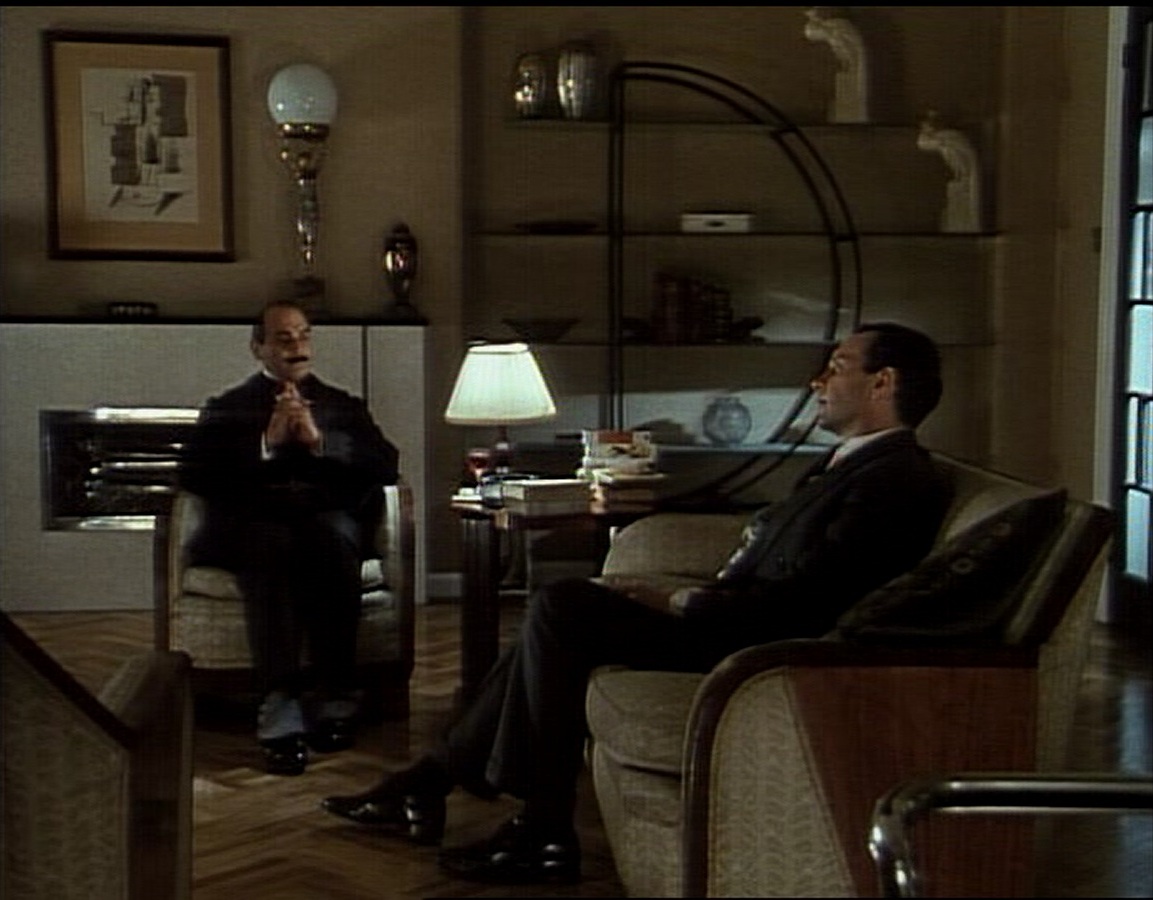
In this post I aim to go a little further. As I was reading Anne Hart’s fantastic biography of Poirot, I came across a chapter on Poirot’s domestic life. This made me consider how faithful the series production designers have been in terms of Poirot’s flat. Many (if not all) aspects of Christie’s descriptions are retained in the two flats.
(I also want to explore the continuity between the first and second flats – and how the changes made in his second flat are more reasonable than one might at first expect. But I will come back to that in a later post.)
All quotations in this post will be from Christie’s descriptions as quoted in Anne Hart’s book, unless otherwise stated.
First, the building itself. Hastings describes Whitehaven Mansions to us as he returns for a visit from Argentina in The ABC Murders:
‘I found him installed in one of the newest types of service flats in London. I accused him (and he admitted the fact) of having chosen this particular building entirely on account of its strictly geometrical appearance and proportions’ (p. 179)


This would obviously be an accurate description of Florin Court as well, the building that was used for the TV series. Florin Court is certainly 'geometrical' in appearance – though I suspect Christie envisioned one with even straighter walls to match Poirot’s personality. As it is, though, the building is a near-perfect representation of Poirot’s home on screen.
In the novels, Poirot is said to live in ‘Flat 203’ (p. 180). His first Whitehaven flat in the TV series is not given this number. Instead, the producers settled on 56B – probably because they adapted ‘The Third Floor Flat’ in the first series and wanted Poirot to live in the same building, i.e. two floors above the scene of the crime (like in the short story). His second Whitehaven flat, however, has been given the 203 number, which is somewhat surprising (see images below). Notice also that both flats share the same address: 'Sandhurst Square'.


So, what of the rooms in the flat? There is evidence of a ‘square white lobby’ (p. 180). This is not recreated in the first flat, but there is a lobby of sorts in the second flat – though this one is admittedly not white. Moreover, a ‘hall stand’ for coats and an ‘umbrella stand’ are mentioned (p. 180). These are present in both flats.


From the lobby, a visitor ‘would have been led down a ‘narrow hall’’ (p. 180). In the first flat, this was very much the case. In the second flat, this narrow hallway is less evident, though that depends on how you look at it. Poirot has a separate office in this flat – which is basically just an extension of the living room – and the office is placed down a narrow corridor from the main entrance, so if one imagines that visitors were led to that particular room (which they occasionally do in the episodes), this would still be in keeping with the novels.


The living room is described as ‘shining’ and ‘gleaming with chromium’ (p. 180). Admittedly, there isn’t much chromium in either of the flats (perhaps apart from the chairs in the first flat – see image below), but the ‘shining’ element is certainly included in both, with several glossy surfaces on the furniture. Moreover, another description seems to highlight the squareness of the room:
‘A square room, with good square modern furniture – even a piece of good modern sculpture representing one cube placed on another cube and above it a geometrical arrangement of copper wire’ (p. 181)The squareness of the room is questionable in both TV-flats, but there is certainly square and modern furniture in both. In terms of the ‘modern sculpture’, no such object is present in any of the flats, as far as I can see. However, there is a tremendous amount of art/sculptures, more generally speaking.


The screencaps below are just a few examples of art and sculptures in both flats. Anne Hart explains that ‘Poirot’s taste in art is described as ‘always somewhat bourgeois’ and tending towards the ‘opulent and florid’ (p. 182). And there are descriptions of etchings on the wall (p. 181). Judging by the examples below, this seems to have been taken into account in both flats, though arguably more so in the first than in the second.

In the novels, the living room has a ‘square fireplace’ with a ‘chromium-plated curb’ (p. 181). Both TV-living rooms have a fireplace (the second one has two – or at least two openings, one on either side of the wall), but neither is particularly chromium-plated (see below).


Moreover, the area in front of the fireplace is described as follows: ‘On the mantelpiece sat a clock, over it hung a mirror, and on either side of the hearth sat two square armchairs placed at ‘a definite geometrical angel’. A sofa and a number of upright chairs completed the seating arrangements ’ (p. 181).
None of the flats have included a mirror over the fireplace (probably because it would be difficult to prevent reflections of cameras and lighting equipment from being seen on screen). Instead, they both have a piece of art. There is also a clock on one of the mantelpieces in the second flat (see above), but not in the first flat. Finally, both flats have chairs and sofas in front of the fireplace, and they are all placed at ‘a definite geometrical angel’.
Poirot’s desk is another central element in Christie’s descriptions of the living room. As Anne Hart points out, ‘Poirot was particularly fond of his ‘handsome modern desk’, which sat near the window. Its squareness and solidity were more agreeable to him than the soft contours of antique models’ (p.181). Both desks in the TV flats certainly look solid and square (see below).


There is also a description of several tables: ‘In a small alcove stood a table (…) and other small square tables were carefully placed around the room’ (p. 181). I haven’t noticed any in the first flat, but the second one certainly has several (see below). There is also a table, not in an alcove, but close to where the window/room bends inwards (see the far right of the image below or the image with curtains further down the post).


‘At the windows hung curtains (perhaps made from the purple and gold material Poirot purchased in Assuan in Death on the Nile?)’ (p. 181). Both flats have curtains – and funnily enough, the first flat seems to have curtains of gold material (and red, not purple, but still!).


‘Also in the sitting room was a large bookcase. Poirot could be very upset (…) if a book was improperly shelved’ (p. 182). In the first flat, there is a tiny bookcase (if you can call it that) close to Poirot’s desk, while in the second flat, there is a large bookcase covering an entire wall (though admittedly in the separate “office” and not in the actual sitting room. Both in earlier episodes and in the later ones, Poirot’s reordering of books is pointed out. (It has always annoyed me that the first flat does not, in favt, have a proper bookcase. I feel certain that someone of Poirot's caliber would have a large collection of books.)


‘The bookcase also held a collection of reference files’ (p. 182). Not true of the first flat, but probably in the second? Look to the right of the image below. Those seem like reference files to me! (And for those of you familiar with my chronology, this would make sense as Miss Lemon is no longer employed, and Poirot needs to store his reference files somewhere else (as there is no secretary office in the second flat)).

‘Flat 203 contained seven other rooms: a ‘tiny’ dining-room, sometimes called ‘the other room’ (on display was the fatal knife from Murder on the Orient Express), Miss Lemon’s typing room, Poirot’s bedroom, a second bedroom for guests, George’s bedroom, a bathroom and a kitchen’ (p. 183).


‘The other room’ is not present in the first flat. In fact, that flat seems far too tiny to accommodate all these rooms! (which is possibly why the production designers decided to create a new one?). The second flat does not have a separate dining room, but it certainly has a separate ‘other room’; the “office”. The first flat has Miss Lemon’s typing room, but not the second (again, I refer to my chronology and the fact that Miss Lemon is no longer employed by Poirot). Both flats have a separate bedroom for Poirot. As for George’s room, there is no reason for him to have one in the first flat (since he, in terms of TV chronology, has not been employed yet). While we have not seen his room on-screen in any of the later episodes, it is reasonable to assume that one of the doors in the new flat leads to his bedroom. Likewise with the guest bedroom; never seen on screen in either of the flats, but there is probably one in both flats. Finally, the kitchen and the bathroom have only been seen on screen in the first flat, but it is highly likely that the second flat has them, too.
As to why the two flats look different while still evidently being in the same building, a comment by Poirot in The Clocks (the novel) might shed some light on the issue: ‘They make the renovations, the redecorations, even the structural alteration in these flats’ (p. 192, my emphasis). In my opinion, this solves this issue once and for all. We can assume that at some point in time (why not in the summer of 1937, see my chronology), Whitehaven Mansions underwent significant redecoration and restructuring. Having recently “retired”, fired Miss Lemon and obviously become a very wealthy man, Poirot takes this opportunity to engage the services of George, move into a more expensive flat in the building and acquire new furniture. The flat looks different both because it is a significantly larger one, but also because of the above mentioned restructurings.
Interestingly, a further reference from the same story implies that the walls of the building ‘ had been repainted in pale shades of yellow and green’ (p. 191-2). This is actually shown on screen in Poirot’s new apartment (see images of his hallway/entrance below).


Finally, let me draw your attention to some curious elements. First, there is a description in Anne Hart’s book of 14 Farraway Street, where Hastings and Poirot first lodged. This is obviously not present in the TV series, which has been set much later in Poirot’s career (again, see my chronology). However, notice the following description and see the images below:
‘On the mantelpiece sat ‘a magnificent model of a foxhound’, a trophy of Poirot’s victory over Inspector Giraud of the Paris Sûreté in Murder on the Links’ (p. 173).


The clock is included in Poirot’s new flat! Now, if you remember the particular adaptation of Murder on the Links, the scriptwriter Anthony Horowitz changed the bet between Poirot and Giraud to be about Poirot’s moustache and Giraud’s famous pipe (not mentioned in Christie’s novel), so there is no reason why Poirot should have this in his flat. However, this is certainly a nice touch by the production designer for those of us who are familiar with Christie’s novels and not only the TV series. Moreover, there is nothing to suggest that Poirot might not have bought this foxhound for himself as a trophy/reminder, after the actual case (in the TV series).
Secondly, Poirot famously receives a cheque for one guinea from Mr. Todd in The Adventure of the Clapham Cook and Poirot puts it on the wall to remind himself not to dismiss the trivial cases (p. 173). This is included in the adaptation, but the framed cheque cannot be seen on screen in either the first or the second flat after this particular adaptation.

To conclude, then, it seems obvious that the production designers of these two flats (Jeff Tessler on the new and Rob Harris on the old, if I'm not mistaken) have demonstrated a painstaking attention to the detail of Agatha Christie's descriptions - which, quite frankly, makes me love the series even more!