Showing posts with label David Suchet. Show all posts

Monday, 28 July 2014

The Complete Poirot: The Mysterious Affair at Styles

"Some people tend to see Poirot as one- or two-dimensional, but those who do are almost always the ones who have never read the books. If you do read them, you realise at once that there are certainly three dimensions to his character. And every time I played him, I tried to bring those extra elements of Poirot's character to the surface, reflecting the different dimensions revealed in Dame Agatha's own stories about him." (David Suchet, Poirot and Me p. 86, 2013)
It is a truth universally acknowledged (to borrow a famous first sentence) that David Suchet spent years perfecting his performance as Hercule Poirot. He read all the stories and compiled a character dossier, a copy of which was included in his memoir Poirot and Me (2013). He has repeatedly stated that he aimed to stay true to the character as Christie wrote him. For me, Suchet fully managed to inhabit that character, and I find it impossible to pick up a Poirot story and not envisage his Poirot and hear his voice.


Under the headline "The Complete Poirot", I will examine, in the coming weeks and months, the development of our all-time favourite main character in Christie's stories, and discuss passages or characteristics that are (a) included in Suchet's dossier, or (b) present in the television adaptations themselves. The books will be discussed in chronological order (based on this Wikipedia list), rather than in publication order (although they largely overlap).

Let's begin with Poirot's very first case, The Mysterious Affair at Styles, published in 1920. Page references are from the HarperCollins collection The Complete Battles of Hastings, Volume I, published in 2003.

"I came across a man in Belgium once, a very famous detective, and he quite inflamed me. He was a marvellous little fellow. He used to say that all good detective work was a mere matter of method. [...] He was a funny little man, a great dandy, but wonderfully clever." (pp. 10-11)
"Poirot was an extraordinary-looking man. He was hardly more than five feet four inches, but carried himself with great dignity. His head was exactly the shape of an egg, and he always perched it a little on one side. His moustache was very stiff and military. The neatness of his attire was almost incredible; I believe a speck of dust would have caused him more pain than a bullet wound. Yet this quaint dandified little man, who, I was sorry to see, now limped badly, had been in his time one of the most celebrated members of the Belgian police force. As a detective, his flair had been extraordinary, and he had achieved triumphs by unravelling some of the most baffling cases of the day." (p. 20)
These are the first descriptions of Poirot and his appearance in any of Christie's books, courtesy of Arthur Hastings. It seems unnecessary to list the similarities between Poirot and Suchet's portrayal on this point, but I'll do it briefly. There is no denying that Poirot is 'a great dandy', certainly from an English point of view. I suppose that would go under note 22 on Suchet's list: 'Very particular about his appearance', as well as note 33: 'His appearance (including hair) is always immaculate. His nails groomed and shined.' According to the IMdB, Suchet's height is 5' 7'', which is very close to Poirot's 5' 4''. He has an egg-shaped head (enhanced in the particular adaptation of this story, I notice, by the hat (see above)). Note 48 on Suchet's list reads: 'Can't abide being or feeling untidy. A speck of dust is "as painful as a bullet wound".' This refers to the quote above, 'I believe a speck of dust would have caused him more pain than a bullet wound'. It's a characteristic that will flourish both in later Poirot stories and in later Suchet adaptations.

It would be careless of me not to mention the limp, Poirot's war injury. This is one of only two characteristics (as far as I know) that Suchet hasn't included in his portrayal (the other is, of course, the green colour of his eyes). In a BBC Radio 4 interview in 2012, Suchet explained why this is the case: 'The only thing I've never externalised for Poirot is, in fact, in the original books, he has a limp, and it was a choice of my first producer in the series that I shouldn't limp, because if the series goes on too long, it may become a disadvantage! I actually wanted to, so that's the only aspect of Poirot I go on record for saying that I haven't actually achieved; to find his literal war wound.'
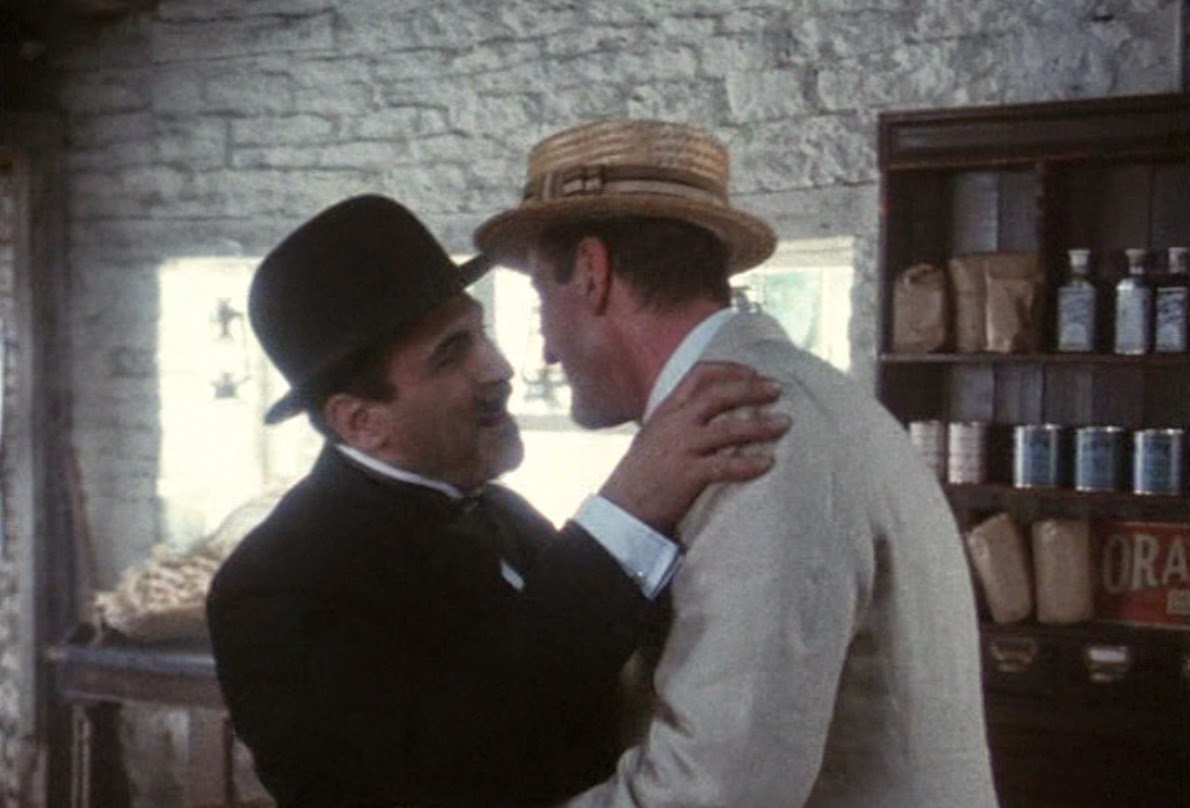
 
'As we drove through the village, I remembered that I wanted some stamps, so we pulled up at the post office. As I came out again, I cannoned into a little man who was just entering. I drew aside and apologised, when suddenly, with a loud exclamation, he clasped me in his arms and kissed me warmly. 'Mon ami Hastings!' he cried. 'It is indeed mon ami Hastings!' (p. 19)
'Suddenly clasping me in his arms, he kissed me warmly on both cheeks, and before I had recovered from my surprise ran headlong from the room.' (p. 149)
A few months back, I was interviewed by Norwegian public radio, and one of the questions I was asked was 'When did Poirot become a 'hugger', someone who displays affection?'. The question was raised in response to Poirot's reunion with Japp in The Big Four. I replied that Poirot, both in the books and the television series, is no stranger to displaying affection, particularly towards people he cares about. Obviously, though, as Suchet points out in note 77, he 'rarely shows his emotions'. In the 2006 Poirot & Me documentary, Suchet referred to the first scene, and the meeting with Japp in The Murder of Roger Ackroyd, as his favourite moments with Hugh Fraser and Philip Jackson.
'Yes, indeed,' said Poirot seriously. 'I know Mademoiselle Cynthia. It is by the charity of that good Mrs Inglethorp that I am here'. [...] 'Yes, my friend, she had kindly extended hospitality to seven of my country-people who, alas, are refugees from their native land. We Belgians will always remember her with gratitude.' (p. 20)
'I looked at the extraordinary little man, divided between annoyance and amusement. He was so tremendously sure of himself. As though he read my thoughts, he nodded gently. 'Oh yes, mon ami, I would do what I say.' He got up and laid his hand on my shoulder. His physiognomy underwent a complete change. Tears came into his eyes. 'In all this, you see, I think of the poor Mrs. Inglethorp who is dead. She was not extravagantly loved - no. But she was very good to us Belgians - I owe her a debt.' (p. 72)
These two quotes refer to Poirot's background as a war refugee. This is rarely referenced in the series (I can only think of 'The Double Clue' and The Clocks), but it plays centre stage in the Styles adaptation.
 
'A window above me was cautiously opened, and Poirot himself looked out. He gave an exclamation of surprise at seeing me.' (p. 31)
In Poirot and Me (2013), Suchet discusses to the way this particular scene was adapted for the screen: 'It is to my eternal regret that this is one occasion when I totally let down the man I had become so close to. In the film, I open the window and look out without brushing my hair before doing so. Now, Poirot, the man I knew and loved, would never, ever, have done that. He would have brushed his hair carefully, no matter how urgent the knocking on his front door. To this day, I regret that I didn't brush my hair before opening the window. Every time I see that scene, I feel I've let him down.' (p. 97). So this is a very obvious breach of his mantra - true to Agatha. However, this explanation should more than make up for it. The quote further underlines his attention to detail and care for the character.
'Poirot smiled kindly on me. 'The mind is confused? Is it not so? Take time, mon ami. You are agitated; you are excited - it is but natural. Presently, when we are calmer, we will arrange the facts, neatly, each in his proper place. We will examine - and reject. Those of importance we will put on one side; those of no importance, pouf!' - he screwed up his cherub-like face, and puffed comically enough - 'blow them away!' (p. 32)
One fact leads to another - so we continue. Does the next fit in with that? A merveille! Good! We can proceed. This next little fact - no! Ah, that is curious! There is something missing - a link in the chain that is not there. We examine. We search. And that little curious fact, that possibly paltry little detail that will not tally, we put it here!' He made an extravagant gesture with his hand. 'It is significant! It is tremendous!' (p. 32)
These two quotes illustrate Poirot's methodical approach to detective work. The first was even lifted straight from the page and onto the screen. Suchet's Poirot approaches every case in much the same way.
 
'He was carefully engaged in brushing his coat before putting it on, and seemed wholly engrossed in the task.' (...) He opened a drawer, and took out a small dispatch-case, then turned to me.' (p. 32)
See Suchet's Note 72: 'Always brushes his coat before venturing outside. A clothes brush is nearby'. The dispatch-case was included in the adaptation, too. It was never used again, though Poirot did use a similar one in the adaptation of The Big Four, as he examined the chess board.
 
'Excuse me, mon ami, you dressed in haste, and your tie is on one side. Permit me.' (p. 32)
'He's such a dear little man! But he is funny. He made me take the brooch out of my tie the other day, and put it in again, because he said it wasn't straight' (Cynthia to Hastings, p. 124)
See Suchet's Note 84: 'He often straightens Hastings' tie. He will remove a lady's brooch and replace it because it was put in crooked (M. Affair at Styles - Cynthia p. 130)'. See also Note 86: 'Cynthia from M. Affair at Styles says: 'He's such a dear little man! But he is funny.'. Both qualities would re-appear in later stories and adaptations.
'Poirot stopped for a moment, and gazed sorrowfully over the beautiful expanse of park, still glittering with morning dew. 'So beautiful, so beautiful, and yet, the poor family, plunged in sorrow, prostrated with grief.' (p. 33)
This is a small glimpse of the darkness to the character, that would later be explored in more detail by Suchet.

'He rose from his knees, and walked slowly across to the mantelpiece, where he stood abstractedly fingering the ornaments, and straightening them - a trick of his when he was agitated.' (p. 37)
'Poirot had walked over to the mantelpiece. He was outwardly calm, but I noticed his hand, which from long force of habit were mechanically straightening the spill vases on the mantelpiece, were shaking violently.' (p. 64)
Suchet's Note 31: 'A PASSION for tidiness and will always straighten objects if crooked or unsymmetrical.' Of course, as Hastings points out in the quote, this is particularly the case when he is agitated. Suchet's Poirot does it a lot, especially in the later episodes. Nearly every interview takes place in a drawing-room by a fire place so that he can straighten the objects!
'Finally, he poured a few drops of the cocoa into a test tube, sealing it up carefully. His next proceeding was to take out a little notebook. 'We have found in this room', he said, writing busily, 'six points of interest.' (p. 37)
See Suchet's Note 30: 'Sometimes uses a pocket notebook'. Suchet uses a notebook in the episode.The test tube is an example of Poirot's more forensic approach in The Mysterious Affair at Styles. In later years, he would declare his disdain for tangible evidence.
From "The Adventure of Johnnie Waverly"
'He had stepped outside the french window, and was standing, apparently lost in admiration, before the various shaped flower beds. 'Admirable!' he murmured. 'Admirable! What symmetry! Observe the crescent; and those diamonds - their neatness rejoices the eye. The spacing of the plants, also, is perfect.' (p. 40)
See Suchet's Note 12: 'Likes neatness - can't tolerate a mess or anything disorderly'. Suchet's Poirot frequently refers to the symmetry of his surroundings.
'In her attitude towards Poirot, she was inclined to be suspicious, but he soon broke down her defences. He drew forward a chair. 'Pray be seated mademoiselle' [...] Poirot looked at her keenly. 'My good Dorcas, it is necessary that I should know every detail of that quarrel as fully as possible. Do not think you are betraying your mistress's secrets. Your mistress lies dead, and it is necessary that we should know it all - if we are to avenge her. Nothing can bring her back to life, but we do hope, if there has been foul play, to bring the murderer to justice. (p. 41)
The quote above illustrates Note 61: 'Very good with servants and working classes. Never patronises them'. A similar scenario can be found in 'The Adventure of the Clapham Cook', both the story and the adaptation.
Poirot observed me with quietly twinkling eyes. 'You are not pleased with me, mon ami?' (p. 48)
See Note 17: 'A great "Twinkler". Has very "twinkly eyes" (green!!)'. Suchet based his performance in the early series on this particular characteristic. His Poirot would be charismatic, friendly and likeable (despite of his other character traits). Other characteristics would become more important in later years, but Suchet's Poirot never lost his twinkle.
'Oh, lá lá! That miserable cocoa! cried Poirot flippantly. He laughed with apparent enjoyment, raising his arms to heaven in mock despair, in what I could not but consider the worst possible taste.' (p. 49-50)
Again, Suchet's Note 77 serves as an illustration: 'Rarely shows his emotions and yet dislikes the English reserve. Sometimes though with his arms raised he will utter "Oh lá lá"!'. However, unless I am mistaken, Suchet never makes use of this particular exclamation in the television series. But certain exclamations of joy are evident in the series on momentous occasions (typically an 'ah!' followed by raised arms and a smile).
'Chut! no more now!' (p. 54)
'Tcha! Tcha! You argue like a child!'
(p. 99)
See Note 80 on Suchet's list: 'WIll utter "CHUT!" instead of "Ssh"' and Note 47: 'When dissatisfied, restless, frustrated or angry will make the sound of a cat sneezing "Tchat".' The former is not a particularly common occurrence in the series, but the latter can be observed in several of the books and adaptations.
'But what was it?' 'Ah!' cried Poirot, with a gesture of anger. 'That I do not know! [...] And 1' - his anger burst forth freely - 'miserable animal that I am! I guessed nothing! I have behaved like an imbecile! [...] Ah, triple pig!' (p. 64)
Both in Styles and in later adaptations, this character trait would be displayed. Suchet explains in the 2006 documentary: 'Very often, both in the books and in our series, you see Poirot very nearly getting it wrong. I suppose it's one of the few times that you really see Poirot getting emotional. When he does get it wrong (...) he gets very angry with himself, and calls himself an idiot and an imbecile (...) which is something completely out of character, because he would never normally admit to this sort of thing. (...) Poirot does it, because that's his greatest crime to himself; getting it wrong.'
'As we walked briskly away from the house, I glanced at him more than once. I had often before noticed that, if anything excited him, his eyes turned green like a cat's. They were shining like emeralds now. 'My friend', he broke out at last, 'I have a little idea, a very strange, and probably utterly impossible idea. And yet - it fits in.' (p. 66)
I was opening my lips, when Poirot stopped me with a gesture of his hand. 'Not now, not now, mon ami. I have need of reflection. My mind is in some disorder - which is not well.' For about ten minutes he sat in dead silence, perfectly still, except for several expressive motions of his eyebrows, and all the time his eyes grew steadily greener. At last he heaved a deep sigh. 'It is well. The bad moment has passed. Now all is arranged and classified. One must never permit confusion. (p. 71)

'Still frowning, he went across to the desk and took out a small pack of patience cards. Then he drew up a chair to the table, and to my utter amazement, began solemnly to build card houses! My jaw dropped involuntarily, and he said at once: 'No, mon ami, I am not in my second childhood! I steady my nerves, that is all. This employment requires precision of the fingers. With precision of the fingers goes precision of the brain. And never have I needed that more than now! [...] I can build card houses seven storeys high, but I cannot' - thump - 'find' - thump - 'that last link of which I spoke to you' [...] It is done - so! By placing - one card - on another - with mathematical - precision!' I watched the car house rising under his hands, storey by storey. He never hesitated or faltered. It was really almost like a conjouring trick.' (p. 148)
'I stopped suddenly. For Poirot, uttering a hoarse and inarticulate cry, again annihilated his masterpiece of cards, and putting his hands over his eyes swayed backwards, and forwards, apparently suffering the keenest agony. [...] 'I have an idea' (p. 148-49)
These quotes all need to be discussed together, because they concern Poirot's moment of revelation, the epiphany. It's a frequent occurrence, both in the series and in the stories. Suchet refers to it in Note 82, which is a direct quote of Hastings's description on p. 71); 'Four about ten minutes...'. Suchet also refers to the 'little ideas' in Note 83: 'He enjoys his "little ideas" - this became a catchword. Indeed it did, both on TV and in Christie's stories. The card house would reappear in later adaptations, see 'The Disappearance of Mr. Davenheim', Three Act Tragedy.
From "The Mystery of the Spanish Chest"
'He offered me one of the tiny Russian cigarettes he himself occasionally smoked. I was amused to notice that he stowed away the used matches most carefully in a little china pot.' (p. 70)
See Suchet's Note 38: 'Smokes tiny black Russian cigarettes from a cigarette case (silver)', and note 85: 'When he hasn't got his lighter, will light his small Russian cigarettes with a match stick which he will then place in a small pottery pot'. His smoking habit is particularly evident in later episodes. I can't remember seeing him use a china pot, though.
Mon dieu! (p. 86)
See Note 76: 'Never or very rarely says "Mon Dieu!" But often will exclaim "Sacré", "Milles Tonnerres!". It's certainly true that the two latter exclamations are more common, but I'm fairly certain I've heard Suchet's Poirot exclaim mon dieu on more than one occasion (not to mention in the novels, as the above quote proves).
'Mesdames and messieurs,' said Poirot, bowing as though he were a celebrity about to deliver a lecture' (p. 93)
This is a typical example of Poirot's 'moment of theatre', as Suchet calls it.
'Sometimes, I feel sure he is mad as a hatter; and then, just as he is at his maddest, I find there is method in his madness' (p. 125)
See Suchet's Note 87, which is a direct quote of the above statement. Suchet's Poirot does seem to provoke this reaction in people, as he is often accused of having lost his mind or following the wrong track.
'The happiness of one man and a woman is the greatest thing in all the world' (Poirot to Hastings, p. 169)
It seems fitting to end the first examination of Suchet's portrayal with this quote, because it reflects Poirot's appreciation and admiration for marriage and relationships, a character trait Suchet would explore further and broaden in the second half of the series. See Note 89: 'Genuinely believes that the happiness of one man and one woman is the greatest thing in all the world'.

Next time, I'll take a closer look at the first short stories!

Monday, 18 November 2013

REVIEW: David Suchet's 'Poirot and Me' (2013)

Last week, Agatha Christie's Poirot came to an end as Curtain: Poirot's Last Case was broadcast on ITV. But fear not! To coincide with the broadcast of the final series, Headline Publishing have released a book, written by David Suchet in collaboration with Geoffrey Wansell, called Poirot and Me. The book is an absolute must-have for any dedicated Poirot fan!
When I first heard about the plans for this release back in autumn 2012, I was immediately over-excited. Having seen numerous interviews with Suchet in the past, as well as his documentaries, I was confident that we could expect great things from this book. In short, my expectations could not have been higher. This is the man who for twenty-five years has portrayed one of my favourite literary characters in an iconic television series. 

Let me start by saying that it did not disappoint. Far from it. With over 300 pages, the book includes comments on every single episode ever made, plus some biographical Agatha Christie information. For the first time, we get the full story of how Suchet became Poirot (the walk, the talk, the appearance), with first meetings, first costume fittings, first shoots and several acting epiphanies included. We are also treated to little anecdotes from his encounters with the Poirot fans, some of which are absolutely delightful to read. We even get his 'character dossier', the list of 93 Poirot characteristics that he carried with him on set (I was secretly hoping for this to be included, but I never thought we'd actually get to see it!), and a series of photos Suchet has taken on the sets over the years. 

This is far more than just a Poirot 'encyclopedia', though. This is the life story of a character actor. I don't think I have ever seen a character actor who has been given the opportunity to describe the process of becoming different characters. In short, his craft. Poirot aside, we also get glimpses of all the other great characters Suchet has played, including the famous Shakespeare roles, George in Who's Afraid of Virginia Woolf, Salieri in Amadeus, Robert Maxwell in Maxwell, James Tyrone in Long Day's Journey Into Night, and many others. We get to share his anxiousness as he waits for the phone call from ITV saying that they want to do another series, his money worries, and holidays with his family. Sometimes when you read 'celebrity biographies' you can tell that it has been 'polished' by some PR department, and certain stories have been included to put the writer in a good light. This, however, is a very personal story told in what appears to be a very truthful and honest manner. Geoffrey Wansell should probably be given some credit here, too, because the book is incredibly 'visual', in the sense that you really feel, as a reader, that you've actually witnessed all these things. You have been a part of Suchet's journey. That is quite unusual. 

Personally, there were some things I was even more delighted to read about than others. It was encouraging to read about Suchet's disputes with some of the Poirot directors, his determination to re-introduce Whitehaven Mansions after a long absence and include Poirot's manservant, his personal contributions to the set designs (he bought the clock on Poirot's mantelpiece for the production team!), and his firm belief to stray true to the character. This is a man with a vision. In fact, that's a thought I kept coming back to while reading the book. On several occasions, Suchet has said that his aim as an actor is to serve the writer. 'Without actors, writers don't have a voice'. These glimpses behind the scenes demonstrate Suchet's determination. He has been committed to Agatha Christie, regardless of what some Christie 'purists' might say, while at the same time fleshing out Poirot to truly iconic dimensions (see my post on Suchet's achievement here). His reflections (in the book) on Murder on the Orient Express and the moving story from the filming of Poirot's final case, Curtain, underline this, too. 

All in all, Poirot and Me is a treasure-trove of information for any fan of David Suchet, Hercule Poirot, and Agatha Christie - not to mention anyone interested in acting, television and adaptation work. Highly recommended! 

P.S. I've been told by Headline that an audiobook version will be released on 21 November 2013, read by David Suchet! The book lends itself easily to an audiobook, and I'm sure the story will feel even more personal when read by Suchet himself.

 
Richard, a reader of the blog, kindly sent me these photos from one of Suchet's promotional talks. It must have been quite an evening for you!

Saturday, 5 October 2013

A very eventful (Poirot) autumn!

(c) ITV
As we await the UK broadcast of the final episodes (and envy those people in Poland who have already seen The Big Four!), there's lots of exciting things happening in a couple of weeks; a preview screening, a book, a UK tour and a soundtrack album! Let's have a look:

29 October 2013: Dead Man's Folly Preview + Q&A
BFI Southbank, 6:20 p.m. Tickets £11. On sale from 8 October.

Yes, you read that correctly. The British Film Institute in London is hosting a preview screening of Dead Man's Folly, in association with BAFTA. I quote from their website:
'Introduced by Mathew Prichard, Agatha Christie’s grandson and Chairman of Agatha Christie Ltd. Interview and audience Q&A with David Suchet, who discusses the role and his departure with his biographer Geoffrey Wansell. It has always been David Suchet’s ambition to bring Agatha Christie’s canon of works to completion. Join us for this significant moment in UK broadcasting history.'
[This leads me to believe that the UK broadcast date for this episode will follow shortly after the preview, since this tends to be the case with BFI previews. Also, script editor Thom Hutchinson has reported on Twitter that Dead Man's Folly will be the second episode to air in the UK]

7 November 2013: Poirot and Me by David Suchet is released
Available for pre-order on Amazon.co.uk

I've mention this before. It's (almost) as interesting as the new episodes; David Suchet's story of how he developed the character (plus loads of photos etc.). Should be a great Christmas present for any Poirot fan.

7 November - 10 December 2013: David Suchet Poirot and Me Tour

Next on the list is a promotional tour to coincide with the release of the book. He will visit Theatre Royal Nottingham (7 November), Chepstow Drill Hall (10 November), Chorleywood Memorial Hall (11 November), London/Dulwich (12 November), and finally, Harrogate (10 December). More information here.


11 November 2013: Poirot - Music from the TV Series is released
Available for pre-order on Amazon.co.uk

Yes, we have a new soundtrack! They're spoiling us this year, with the re-release of Gunning's score earlier this year and now this release, with music by Stephen McKeon (Series Ten and Eleven) and Christian Henson (Series Twelve and Thirteen).


Now, the final track, 'Adieu Poirot' seems to suggest some sort of version of Gunning's theme. Having searched the Internet for more information, I think this might be 'Adieu Poirot' by Amy Dickson, which is basically a re-recording of Gunning's 'The Belgian Detective'. You can listen to it on Spotify or buy her album on Amazon. But we can't be sure until we've heard the album, I suppose.

November/December: Dead Man's Folly, The Big Four, Labours of Hercules?

Judging by all of the above, as well as other rumours, I think it's safe to say that the UK will get the next episodes from November onwards. As mentioned, Dead Man's Folly will be the second episode, which means the most likely broadcast order is Dead Man's Folly, The Big Four, Labours of Hercules and finally Curtain. But it would be nice to have a press release from ITV.

UPDATE: We now have a press release. And The Big Four will be the second episode to air. This means the most likely broadcast order will be The Big Four, Dead Man's Folly, Labours of Hercules and Curtain. Also, according to play.com, the Collection 9 (Series 13) DVD has an estimated release date; November 18th 2013! If that's correct, we'll get to see the final series a lot sooner than we expected. Thanks to Paul who alerted me to this.

Wednesday, 2 October 2013

The old gang is back - photo released for 'The Big Four'!

A big thank you to the anonymous commenter who alerted me - here's the first promotional photo for The Big Four! It's amazing to see the 'Big Four' (Poirot, Hastings, Japp, Miss Lemon) back together again!
 

Source: http://www.cyfraplus.pl/ms_galeria/fotobase/41551_c.jpg. Copyright ITV.

UPDATE: Commenter "ueetba" just alerted me to two more photos (see below)!


Source: http://www.alekinoplus.pl/program/film/poirot-wielka-czworka_41551. Copyright ITV.

Tuesday, 24 September 2013

Vote for Poirot and David Suchet in the National Television Awards!

(c) ITV
I've never understood why David Suchet has never been awarded a BAFTA award for his performance as Hercule Poirot. I live in hope that it might happen next year. What a way to celebrate 25 years in the role!

In the meantime, the UK National Television Awards is a good second option. This year, they've added a new category called 'TV Detectives'. David Suchet is nominated (obviously). There will be tough competition, with loads of brilliant nominees, but I think it's worth a try. Also, if the information on Wikipedia is correct, Poirot has never won a National Television Award. So - if you love the series as much as I do - go to the National Telelvision Awards website and vote!

Saturday, 31 August 2013

David Suchet's 'Poirot and Me' now available for pre-order on Amazon


I've mentioned this project before on the blog, but now's the time to give it a full blog post. Back in October 2012 (just as production began on the final series), it was announced that Headline Publishing had acquired the rights in Poirot and Me, a book by written by David Suchet in collaboration with Geoffrey Wansell. It was to be published in autumn 2013.

At the time, Headline's Emma Tait stated: 'I am so excited to be publishing this book, which offers a unique opportunity in television publishing. Rather than an outsider's overview, it is the story of an iconic role told by the actor himself and it is fantastic to be working so closely with David and Geoffrey. I believe it will be a very special book and a wonderful way for David to bid farewell to his old friend Hercule Poirot.' David Suchet and Geoffrey Wansell released a joint statement: 'We are thrilled to be given this chance by Headline to bring his portrayal of Hercule Poirot to life for his millions of fans around the world. It's a wonderful – and rare – opportunity for a character actor to be able to explain his life and craft and exactly how he brought such a famous character to television audiences in more than eighty countries.'

Now Amazon.co.uk have made the book available for pre-order. The book will be released November 7, 2013. Se also Headline's page on the release. Reportedly, this is Suchet's personal story of how he researched and 'became' the iconic character (over 320 pages). The book is said to contain lots of his personal photos from the sets over the years. This should be a very interesting read and a perfect companion to the series!

P.S. Judging by this article from the Independent, the final four episodes are set to be shown in November, which means the book's release will coincide with the broadcast of Series Thirteen (and that makes sense, doesn't it?)

Friday, 28 June 2013

The Final Day...


As many of you will know, this week marked the end of the shoot for the final episode of the final series of Agatha Christie's Poirot. If we include the rehearsed reading of Black Coffee, and assume that all the short stories of Labours of Hercules will be referenced in some way, we can conclude that David Suchet has now starred in adaptations of every single Poirot short story, novel and play ever published by Agatha Christie. That is quite an achievement. His last day on set must have been such an emotional moment, just like the end credits of the final episode, Curtain, will certainly be an emotional moment for all us fans out there. I'll offer some more thoughts on the subject once that episode has aired, but until then, suffice to say a big T H A N K Y O U to David Suchet for dedicating such a large part of his career to this funny little Belgian. This has been 25 years of excellence, 25 years of pure perfection.

P.S. The photo I've chosen is from the Facebook page of Greenway Ferry. It was apparently taken shortly after they finished shooting the final scene of Dead Man's Folly. Notice how Zoë Wanamaker is holding David Suchet's hand. It must have been such a poignant day.

Wednesday, 29 May 2013

'Elephants Can Remember' UK broadcast date confirmed - 9 June 8pm!

(c) ITV
...and we're off! Agatha Christie's Poirot Series Thirteen is on! The press release was issued about a week ago, with a strange embargo on publishing details. Anyway, now we have the official confirmation of the broadcast date (see this article, and this article for some lovely press photos)! Really excited to see some pictures from the episode, I love the house they seem to have used. And of course the fact that Poirot's flat is back on screen. It could just be the time of year they shot it, or even the way the photos were taken, but they do seem to have a rather bleak look about them - reflective of the adaptation as a whole, perhaps?

Also, just a few tidbits of information from the press release (everything has been on IMdB for months, actually). The series now has a new producer (David Boulter), who I think is the fifth producer on the show. The screenplay is by Nick Dear, who has written absolutely wonderful scripts before, particularly for the Ariadne/Poirot coupling, so this should be good. The best news, in my mind, however, is that Christian Henson is back to do the score, presumably for the entire series. After Gunning, he is definitely a good choice. Expect to hear references to the famous theme tune in future episodes.

Finally, just a few interesting bits from the interview with Suchet:
"Viewers should be able to see from 25 years ago to now that the character himself is still there and hopefully hasn’t changed and is the Agatha Christie character from day one."

"As well as watching ten hours of footage and perfecting his mannerisms, I also conduct a detailed script study to make sure everything I say is valid, especially when I come to Poirot’s summing up. I work very, very closely with the script editor to make sure there are no assumptions and it is all fact.In addition to the character preparation I like to rewrite my script in the vernacular of Poirot." (This is actually very reassuring news, it means he has a significant say in what happens in each episode, see below as well)

"Quite a lot now (of influence as associate producer), more so on the scripts before we start shooting and everyday I’m on the set I can always have an input if I see things that are not going quite right. Cast and crew can also come to me with a problem if our producer is not available. I like it very much because I’m the only one really that’s been there from the beginning so I can be very useful and helpful hopefully!"

"One is always in a situation with the adaptation of books and I get letters from Poirot diehards saying ‘oh its moved too far away from the book.’ Very often the books themselves are not that filmable from a commercial point of view. For instance, they maybe set in one setting and the audience loves us going out to other locations. Sometimes the stories do get changed but they are always pretty close to the book."
(Perhaps less reassuring, but I personally don't mind changes as long as they work - and it's good to hear that they are aware of that).

P.S. I'm not in the U.K., so I won't get to see the episode yet (unless someone puts it up on YouTube or something, but I'm not sure I want to see it there first). As a result, I'm not going to write anything on it until I've seen it. BUT: If anyone who sees the episode want to e-mail me or post a comment over at poirotchronology.blogspot.com on the chronology matters of the episode (i.e. any references to year, date or historical event), that would be much appreciated!

Wednesday, 22 May 2013

Countess Vera Rossakoff


Since it is looking increasingly likely that we will see the return of Countess Vera Rossakoff in the final series (Labours of Hercules) I thought I might write down some thoughts on that particular character, the actress who portrayed her in The Double Clue and the rumours of a new actress in the role for Labours.

In Christie's stories - and in the TV series - Poirot first met the Countess in 'The Double Clue', a short story published in the early 1920s. A member of the ancien régime of Russia, she is described by Hastings as a 'whirlwind in human form' (Hart 233), and later as 'big' and 'flamboyant' (Hart 234). By the end of the jewel-robbery case, Poirot is completely enthralled by her:
'What a woman!' cried Poirot enthusiastically as we descended the stairs. 'Mon Dieu, quelle femme! Not a word of argument - of protestation, of bluff! One quick glance, and she had sized up the position correctly. I tell you, Hastings, a woman who can accept defeat like that - with a careless smile - will go far!' (Hart 234)
In later references, Poirot describes her as 'A woman in a thousand - in a million!' (Hart 234), further enhancing our impression that this truly is Poirot's Irene Adler. The two met again in the novel The Big Four (apparently not in the adaptation that was filmed recently). This time around, the Countess was backed by some of Poirot's toughest opponents yet. In the end, she helps Poirot and Hastings escape a certain death, on the terms that Poirot would reunite her with her long lost son. Then, for the third and final time, they met on the escalators of the London Underground in the 1930s, and in the nightclub called 'Hell':
'Though it was something like twenty years since he had seen her last the magic still held. Granted that her make-up now resembled a scene-painter's sunset, with the woman under the make-up well hidden from sight, to Hercule Poirot she still represented the sumptuous and the alluring.' (Hart 237)
After 'The Capture of Cerberus', they were never to see each other again, but in Christie's words, Rossakoff remained 'the flamboyant creature of his fantasy'.

On television, Countess Rossakoff was portrayed by Kika Markham in the 1991 episode 'The Double Clue'. Though the adaptation differs significantly from its source material (I will probably come back to this in greater detail in my 'episode-by-episode' series), I would still count it as one of my favourites - in terms of characterisation and character development. Markham and Suchet are both given much more to play with in terms of the 'relationship' between the characters, with walks in the park, visits to museums and picnics in the countryside. Also, the final scene at the train station has remained iconic. Markham was lovely in the part.

(Rossakoff was also an added plot line in the adaptation of Murder in Mesopotamia, which didn't really make sense to me. I mean, Poirot travelling all the way to Mesopotamia because she has sent him a cryptic message asking for his help? Oh well, I guess it was a nice touch and a way of showcasing his affection for her).

Now, rumour has it, based on this interview, that actress Orla Brady will be playing Countess Rossakoff in Labours. At first, I was slightly taken aback by this. (Not by Brady - she's an excellent actress - but by the recasting). Sure, Markham is older now (72-73, according to Wikipedia, cf. 50 when the episode was shot), but so is Suchet (67 now, 44 then). However, having looked at some recent photos of Orla Brady and compared them to screenshots from The Double Clue, I'm now convinced that this was, if not the right choice, then at least a right choice. As has been mentioned on the IMDb forum recently, Brady is closer in age to what the character would be in chronology terms (if we rely on my chronology, The Double Clue is set in the mid-30s and Labours will hopefully be set just before WW2). Also, she looks remarkably similar to Markham in 1990! In other words, the recasting will somewhat ease the chronology issues, and the two actresses are sufficiently similar not to annoy viewers. (As an aside, I remember when they recast the role of Helen Lynley in the Inspector Lynley Mysteries. That was... Well, they didn't even look remotely similar....).

All in all, I am just happy to see the return of Countess Rossakoff (if indeed that is the case). As I have mentioned elsewhere, I think her presence in one of the remaining episodes is absolutely necessary to close one of the important chapters of Poirot's life (what I have nicknamed 'Poirot's-lamentation-on-love' storyline).

(Picture copyright ITV, quotations from Anne Hart's The Life and Times of Hercule Poirot)

Wednesday, 20 March 2013

ITV's MIPTV promo

ITV has updated their promo site for MIPTV, a yearly television market event in Cannes, France. See this link: http://mip.itvstudios.com/. There are promo trailers for several ITV series, including Poirot and Marple. Both trailers are unchanged from last year's event, I think, which is somewhat disappointing as their trailer in 2009 previewed Murder on the Orient Express, and I was hoping for a glimpse of the final series. But if you haven't seen the trailer before, you might find it interesting. Also, they seem to have included a photo from the final series, one from Poirot's office (see below). Or, at least, I assume it is from the recent filming, because the pen and ink stand on the desk is different from any previous series, and the Marple promo definitely has a recent photo (from the filming of A Caribbean Mystery, I guess).

The promotional text on Poirot is also quite nice. If I were a television channel looking for series to purchase for national broadcasts, I would definitely be tempted:
For over 25 years, David Suchet has portrayed the inspired Belgian investigator, Hercule Poirot; creating a unique catalogue of timeless crime fiction. In an emotional farewell, Suchet returns as Agatha Christie’s number one detective to take on his final cases. He promises to go out in thrilling style, conquering a global conspiracy re-uniting him with old friends Japp, Hastings and Miss Lemon; and delving into a dangerous family mystery with crime writer Ariadne Oliver. Finally, the detective returns to Styles – the location of his first case, and whilst he may be weakened by age and poor health, his mind is as sharp as ever. He is on the hunt for a killer, and with more victims succumbing, an incapacitated Poirot becomes desperate… At the final curtain, has he at last met his match?
Oh, and interestingly, Philip Jackson's Japp is listed as Assistant Commissioner in the cast list! Surely, that must be a clue to how the character is to be reintroduced in The Big Four...

Tuesday, 19 February 2013

Hastings, Japp and Lemon back for 'The Big Four'


It is fantastic to finally have an official confirmation from ITV on this (not that David Suchet's Twitter isn't official, but it's nice to see it in a press release). Also, I think it's the first press release since they commissioned the final five in November 2011, so it was about time to get some news (again, Suchet is doing an excellent job with that on his own!).

So, The Big Four will reunite the "big four" (Poirot, Hastings, Japp, Lemon). How fitting! I must say this is probably the adaptation I am most excited about for the final series (apart from Curtain). Not because it's a particularly good story, it's absolutely over-the-top, but it can really turn into something special in the transition from novel to adaptation.

I won't deny that I am somewhat anxious as to how the absence of the characters will be explained. For one thing, it's been more than ten years in real-world time since they last adapted a story together, and they have (inevitably) aged a bit. And their ageing is more difficult to cover up than Suchet's, both because Poirot is who he is (colouring his hair, the padding etc) and because Suchet seems to have aged less, facially speaking, than the others (no offence). More importantly, though, I really can't fathom how Miss Lemon's presence will be explained! Hastings and Japp is one thing - Hastings comes back from South America, like in the novel, and Japp could still be working at Scotland Yard (though I always assumed he retired). But Miss Lemon just disappeared into thin air after Evil under the Sun, and now that Poirot has moved and refurbished his flat, there's really no place for her.

Admittedly, these questions come from a chronology fanatic, so perhaps I'm exaggerating the issues here. In any case, I have complete faith in the screenwriters, Mark Gatiss and Ian Hallard. Gatiss is a competent adaptor of Christie novels (unsurprisingly, given the brilliant Sherlock series). They have undoubtedly worked something out (as Hallard seems to have hinted to on Twitter).

Two final points to make here. Firstly, based on the press release and Hallard's answers on Twitter, I'm starting to doubt whether Kika Markham (Countess Rossakoff) will be included. It seems somewhat strange to me not to include her in the press release if she was taking part - not to mention that the brief synopsis only touches upon the challenge of the case at hand, not that Poirot is to be reunited with the love of his life. If I'm right, I hope they include her in Labours. That chapter of Poirot's life needs to see a proper end too. Secondly, I'm delighted to see that they have gone for a WWII/spy angle on this one. Not that surprising, but it does make sense - and would hopefully work well with the rest of the series chronology, since they have slowly (and thankfully) moved beyond 1936 in recent years.

Tuesday, 1 January 2013

Behind the Scenes of Agatha Christie's Poirot


There has been a lot of behind-the-scenes material on the series over the years, but sadly, most of it is difficult (if not impossible) to get hold of. I will try to go through the complete behind-the-scenes features (or, at least, as complete a list as I have been able to make). In addition to the documentaries, interviews and Agatha Christie features listed below, there are some rumours circulating that a behind-the-scenes feature was made in the early 90s, though I somehow find this quite unlikely, as they didn't have the DVD/BluRay market we have these days, so why should they make "extras", unless it was to be used for a television broadcast? The interviews/programmes I've tracked down from the early 90s are all television broadcasts, not DVD extras.

1) Agatha Christie: Crime Does Pay (1990)
This seems to be the earliest documentary in which David Suchet comments on his character. It also features a detailed discussion of Christie's literature and her two main detectives. It seems to have been made in conjunction with the 100th jubilee (centenary) of Christie's birth. The documentary also features the only "meeting" between Miss Marple and Poirot (a.k.a. Hickson and Suchet). As of now (December 2012), most of it seems to be availale on YouTube (http://www.youtube.com/watch?v=fvKPXEOIWNI).

2) Agatha Christie: Een Mysterie (
A documentary on Agatha Christie's life, including an interview with David Suchet on the set of The Mysterious Affair at Styles. Narrated by Joan Hickson! Currently available on YouTube (http://www.youtube.com/watch?v=hqnrNSxJ2QM).
3) The Trouble With Agatha Christie (1991)
An oh-so-typical 90s show on Christie's characters, featuring interviews with a lot of experts as well as actors such as Angela Lansbury, Peter Ustinov - and of course David Suchet. Also available (2012) on YouTube (http://www.youtube.com/watch?v=bMh2tyjhHII).

4) The Great Detectives: Hercule Poirot and the disappearing novelist (1999)
This seems to have been lost. At least, I've never managed to track it down anywhere online. I've found to captions: 'Nigel Williams investigates the 10-day disappearance of Agatha Christie, an incident which remains a mystery to this day. With the help of David Suchet and a hotel murder weekend team, he hopes to unlock the secrets of Christie's enigmatic life.' AND 'Nigel Williams profiles Agatha Christie's famous detective Hercule Poirot, explains the enduring appeal of the eccentric Belgian and examines the author's sensational ten-day disappearance'. Judging from these, the documentary seems to centre on Agatha Christie's life more generally rather than the TV series specifically.

5) Behind the Scenes Featurettes from Series Nine (2003-2004)
Probably intended for DVD release, I think these are included in the "complete collections" regularly released by ITV, as well as some separate DVD releases of Series Nine, but I have never managed to lay my hands on them. Apparently they include an interview with producer Margaret Mitchell (Five Little Pigs), an interview with Mitchell and David Suchet (Sad Cypress) and an on-location featurette (The Hollow). The final featurette, from Death on the Nile, I have managed to get hold of. This was available on YouTube for a while, but I can't seem to find it anymore.

5) The Agatha Christie Code (2005)
This documentary apparently features an interview with David Suchet, supposedly on Poirot, but I haven't been able to find it online. I saw some clips from it a few years back, and it didn't seem to feature the series to a very great extent...

6) Behind the Scenes on Series Ten (2006)
This documentary follows the production of the entire tenth series, from The Mystery of the Blue Train, via After the Funeral and Cards on the Table to Taken at the Flood. It includes interviews with several of the main actors and actresses. I don't think it's available online at the moment (apart from in a version dubbed into Russian), but it will probably be included in the final box set, and it is frequently aired on ITV3.
7) Poirot & Me (mini-documentary series, 2006)
This is the brilliant mini-documentary series, which consists of five minute interviews with David Suchet. All are currently available on YouTube, thanks to the wonderful Sanna from the David Suchet Fansite (https://www.youtube.com/watch?v=AKz8-jwj50U).
They are titled:
- Part One: How It All Began
- Part Two: My Most Intriguing Mystery
- Part Three: My Most Humorous Episode
- Part Four: My Favourite Male Star
- Part Five: My All-Time Favourite
- Part Six: My Loneliness as Poirot
- Part Seven: My Favourite Leading Lady
- Part Eight: Poirot Almost Gets It Wrong
- Part Nine: My Most Challenging Location

An episode called "Poirot's Closest Call" was apparently also supposed to have aired, but I have never managed to track that one down. Judging by the TV guides for that particular weekend, it seems to have featured 'The Mystery of the Spanish Chest' (in which Poirot is almost stabbed by a duelling sword).

8) Super Sleuths: Agatha Christie's Poirot (2007)
2006 was certainly a wonderful year for behind-the-scenes material! This documentary is probably the best and features interviews with everyone from the first producers, script writers, main cast (including Suchet, Fraser, Moran AND Jackson!) and experts. It is part of a major series profiling the most famous ITV detective series. Available on YouTube (2012), again thanks to Sanna (https://www.youtube.com/watch?v=RHRiXmYg9yY), and I think it's also available on some US DVD releases.

9) Top of the Cops (2009)
I haven't been able to locate this online. But judging from information on various websites, the premise seems to have been for the viewers to choose their favourite detective (aka cop). What Poirot is doing in a COP competition, I have no idea... Anyway, it only seems to have featured some clips from the show and some archive footage from an interview with Suchet.

9) David Suchet on the Orient Express (2009)
An absolutely delightful documentary, with David Suchet taking on the journey of the Orient Express. He details the history of the train, as well as some stuff on Christie's book and his portrayal of her character. An extra on the US/UK DVD releases of Series Twelve. Currently available online thanks to Sanna (https://www.youtube.com/watch?v=t0KhaKurWQA). Also available in a 'Masterpiece Special' version, I think.

10) The Making of Murder on the Orient Express (2010)
A rather nice featurette behind-the-scenes of the production. Interviews with main cast members, director and production crew. Currently available on YouTube.

11) The People's Detective: Poirot/Holmes (2010)
This is a rather interesting 'documentary' which was part of a series outlining the main crime dramas on ITV and encouraging the audience to vote for their favourite detective. The episode features interviews with Agatha Christie's grandson, Pauline Moran, Anthony Horowitz and David Suchet, among others. Not available online at the moment.

12) The A to Z of Crime: M to P (2011)
A series outlining words from crime drama series (e.g. murder, hanging, Marple, Poirot). Yes, I know. They seem to be running out of ideas! I watched this myself when it was aired, and from what I can remember Suchet only features in a tiny archive interview. Not available online.

13) Crime Connections (2012)
A series outlining the connections between crime dramas (e.g. Shaun Evans appears in 'Whitechapel' and stars in 'Endeavour' (yup, I told you, they're running out of clever ideas)). The series apparently profiles Agatha Christie's Poirot. Not available online- or at least I haven't been able to find it.

14) Perspectives: The Mystery of Agatha Christie (2013)
UPDATE MAY 2013: "Longish", a commenter, reminded me that the Agatha Christie documentary I mention below has now aired and is available on YouTube (http://www.youtube.com/watch?v=JgP_UfPhOVs). There's a brief clip from Suchet's trailer on the set of Curtain, but apart from that this fascinating documentary focuses on Agatha Christie. For most fans, this is an absolute must-see, and Suchet is excellent.

UPDATE NOVEMBER 2013:
15) Interview with David Suchet (2013)
There's a short interview included on the complete DVD box set that was released by ITV. He details the process of becoming Poirot. A decent interview.

16) Being Poirot (2013)

This documentary was broadcast by ITV directly after Curtain. It is a brilliant account of Suchet's commitment to the character. Available on YouTube.

In addition to these, there's the behind-the-scenes book by Peter Haining, Agatha Christie's Poirot: A Celebration of the Great Detective (1995) which should be available through Amazon or Ebay. As of late 2013, there's also David Suchet's absolutely brilliant autobiography, Poirot and Me (2013), which I suggest is an absolute must-have for any Poirot fan.

Thursday, 20 December 2012

The New Companions: Ariadne, George & Spence

In previous posts, I have explored the portrayal of Hercule Poirot himself, as well as his three associates Hastings, Japp and Miss Lemon. This time, I turn my attention to his most recent companions – crime writer Ariadne Oliver, valet George and Superintendent Spence, all of which add depth to Poirot’s semi-retirement.

Mrs Ariadne Oliver
Apart from Hercule Poirot himself, Ariadne Oliver is possibly my favourite of the recurring characters of Agatha Christie’s Poirot. This is in no small part due to the brilliance of Zoë Wanamaker. The crime writer was introduced by Christie in Cards on the Table, and she was to tag along on Poirot’s cases for no less than four decades (1937-1972). Known for frequently changing her hair styles, she was large, had ‘an agreeable bass voice’, ‘fine eyes’ and was ‘handsome in a rather untidy fashion’ (Hart p. 241). She used to drive a small two-seater car, hated to give speeches, but was a starch supporter of having a woman in charge of Scotland Yard. Her flat had an exotically wallpapered living room, giving the visitor a feeling of ‘being in a cherry orchard’ (p. 242). She was a force of nature in herself and had the honour of being the only woman (apart from servants) that Poirot ever regularly addressed by her Christian name: 'It is my friend, Ariadne'.

The list of characteristics above is supposed to exemplify the accuracy of the portrayal of Ariadne Oliver in the series. All the details above are included. An interesting insight into the character development, however, is given by Wanamaker in a 2006 interview. ‘Scanning through all the Christie books Ariadne appears in, I picked up that the character is completely unlike me. She's a big woman, like a battleship. David wears lots of padding as Poirot, but I decided I was not going to go down that route because it's restricting and hot (…). Instead I decided I'd wear something small that gives you a feeling of being substantial, so the costume designer found this transvestite shop which sold fake breasts. They were called ''medium beauties'', and they were really good. We could have had ''super beauties'', but I think I would have looked like Margaret Rutherford in them’.

Wanamaker describes her character as follows: ‘I think Ariadne is a wonderful character – I’m deeply fond of her. I think Agatha Christie wrote Ariadne Oliver as a send up of herself. Ariadne is a crime fiction writer and is pressured by her publishers to constantly produce her Sven Hjerson books: it was the same with Agatha and her publisher constantly getting her to do more Poirot stories! Ariadne is the complete antithesis of Poirot himself, who’s anal and self regarding and egotistical. She has less of an ego but has this fantastic imagination and is slightly mocking. What’s great about Ariadne is her relationship with Poirot. They respect each other but they’re slightly rude to each other, which is wonderful. I think Poirot needs to be sent up a lot and Ariadne does that. I enjoy their relationship very much. It works because they enjoy each other’s eccentricities and respect each other’s minds. Ariadne would make a wonderful detective – she has a great instinct and Poirot constantly mentions that it’s her instinct which often points him in the right direction’ (Halloween Party Press Pack, 2010).

David Suchet agrees that Mrs Oliver adds a lot to the feel of the series. In the same interview, he explains that ‘Poirot and Ariadne Oliver are really good friends and, if you had a compendium of Poirot, Ariadne Oliver would be one of the women in his life. He strikes a deep friendship with Ariadne, although not in any way from the heart. It’s from the head! I think the reason Poirot likes Ariadne is because she is a crime writer and she provides for him another mind that he can tap. She will come forward with her crime writer’s solutions to the situations they find themselves in. Poirot does have a very soft spot for her. I know that because she is the only woman that Poirot ever, in the whole collection of films, calls by her Christian name without a pre-fix. It’s also great fun with Ariadne Oliver because Poirot gets kindly irritated with her, and she gets kindly irritated with him. I think everybody likes to see Poirot with a woman. I think Zoë and I, having known each other for years and having worked in the theatre together, we bring our own knowledge of each other to that relationship’ (Halloween Party Press Pack, 2010).

In my opinion, Zoe Wanamaker has created the perfect Ariadne Oliver, and I very much look forward to her final two outings in series thirteen (Dead Man’s Folly and Elephants Can Remember).

George (Poirot’s valet)
George (or Georges, as Poirot often calls him), is a very minor character in both Christie’s stories and the series. In fact, the part is probably as small as Miss Lemon’s would have been in the series had not the first producers decided to ignore George and expand her character (see previous post). Christie describes the character as ‘intensely English’. He was, if needed, a useful source of information: ‘Master and servant looked at each other. Communication was sometimes fraught with difficulties for them. By inflexion or innuendo or a certain choice of words, George would signify that there was something that might be elicited if the right question was asked’ (Hart p. 177). This had often something to do with social status; ‘ There is a – gentleman to see you sir. (…) Poirot was aware of that very slight pause before the word gentleman. As a social snob, George was an expert’ (p. 177). Interestingly, it was also ‘the habit of Hercule Poirot to discuss his cases with his capable valet’ (p. 177).

Actor David Yelland has had to make as much as possible out of these tiny references. In my opinion, he has certainly succeeded. Due to the exclusion of his character early on in the series, George wasn’t introduced until Taken at the Flood (2006), but the character has since been included in four episodes (as of 2012). Third Girl is probably the best example of Yelland’s portrayal, since George both contributes with observations on visitors, the case at hand, and breakfast. It is a great challenge to make a fully fleshed-out character of George, but Yelland has done it, and I look forward to an emotional finale in Series Thirteen.

Superintendent Albert (Harold) Spence
The character of Superintendent Spence is not a significant one in the Christie canon. He does, however, assist Poirot in three of his later cases: Taken at the Flood, Mrs. McGinty’s Dead, and Halloween Party. In the series, the character has been portrayed by Richard Hope, but the character was deleted from the adaptation of Halloween Party. Spence was never really properly fleshed out in Christie’s stories, and the few references there are to his personality were never included in the series. Interestingly, they also changed his Chrstian name from Albert to Harold. Nevertheless, I think Spence somewhat works in Hope’s interpretation. He is certainly less of a one-dimensional character than some of the other policemen Poirot has tackled in recent adaptations (especially Inspector Morton in After the Funeral, Inspector Kelsey in Cat Among the Pigeons, Inspector Nelson in Third Girl).

P.S. I will hopefully examine a character who really can’t be described as ‘new’ but is likely to make a comeback in Series Thirteen, i.e. Vera Rossakoff, at a later stage. If she is brought back for both The Big Four and The Labours of Hercules, I feel certain that there will be lots to comment on!

The Big Three: Hastings, Miss Lemon and Japp


Image "stolen" from poirot-fans.livejournal.com user queenie97 (linked to source)

Following on from my discussion of David Suchet’s achievement with the character of Hercule Poirot, this article will focus on what Poirot script writer Clive Exton once described as the ‘family unit’ of Agatha Christie’s Poirot; the three companions of Hercule Poirot in his active years as a private (consulting) detective. My main sources here will be the TV specials Super Sleuths (2006) and The People’s Detective (2010), as well as an online interview with Philip Jackson, Peter Haining’s book on the series, and Anne Hart’s brilliant biography, for references to Christie’s work.

Captain Arthur Hastings, OBE
By far the most important of these three companions, both in the books and in the series, Hastings is portrayed by Hugh Fraser. In Christie’s original stories, the character was a constant in Poirot’s life for only seven years and an intermittent companion for twelve more years after that. In total, twenty-six stories and eight novels are narrated by Hastings.

The character was greatly expanded for the television series. As Hugh Fraser points out, ‘Hastings isn’t in very many of the books. In fact, he was put in stories that he wasn’t in, as was Japp and Miss Lemon’ (Super Sleuths, 2006). This was probably primarily because the show’s producer, Brian Eastman, and the original script writer, Clive Exton, both felt that Poirot needed a ‘basic family unit’ and ‘somebody for Poirot to confide in’, as Exton points out. Personally, I mostly agree with this decision, both when it comes to Hastings, Japp and Miss Lemon. Especially in the short stories, they provide a certain sense of continuity and familiarity, and they suit the first phase of Suchet’s Poirot perfectly; the eager and twinkling detective. I am less certain about some of the novels Hastings was added to, particularly Evil under the Sun, which I feel was contrived. However, I do realize that the inclusion of his character in that particular story was a nice way to give Fraser a (temporary) swan song series.

Both Hugh Fraser and the producers wanted to portray Hastings more true to Christie’s characterization than previous film adaptations. Fraser never saw any of the previous interpretations before they started shooting, because he wanted his ‘Hastings to be something quite original’ (Haining p. 74). Brian Eastman once explained that ‘It would have been easy to just show [Hastings] as a bit of a dolt, (…) but though there are a lot of people who do see Hastings this way, Agatha actually uses him in the books as the voice of the common man. He asks the questions that the reader is asking at any given moment in order to allow Poirot to appear very bright and explain everything’ (p. 76). Fraser set out to read some of Christie’s stories before they started shooting. He describes Hastings as ‘a likeable chap’ who is ‘very laid back’ and ‘a bit of a dilettante’, a man who has ‘fallen into detective work by chance’ (p. 74-76). Fraser is certain that the relationship between Poirot and Hastings is ‘a working relationship and that Poirot actually employs him’ (p. 76). In my mind, this theory is truly fascinating, as it would explain why Hastings is constantly around Poirot’s flat. In Christie’s stories, he is at one time described as working for Lloyds, another time as 'a sort of secretary to an MP'. No matter what he was doing, it always seemed a bit a stretch that his employers would give him so much time off work to tag along on Poirot’s cases, so this subtle change, if never actually explicitly stated in the series, makes a lot of sense.

Hugh Fraser’s portrayal is certainly different from Christie’s characterization in many respects. For one thing, he (or the producers, more likely) has skipped the conventional ‘toothbrush’ moustache. I suspect this was a conscious decision in much of the same way as the producers decided not to have Belgians or Frenchmen in the series with French accents – it would simply be confusing for the viewer and distract from the stories. Also, I have a distinct feeling that having two mustachioed main characters would just be a bit too much and remind us more of an episode of ‘Allo, ‘Allo than Christie. Moreover, TV-Hastings is probably older than Christie-Hastings. In Christie's originals, Hastings is thirty in Styles, while Poirot is about sixty. In the series, Fraser and Suchet are almost exactly the same age. I don’t know if this was done simply because Fraser was the best actor for the job – or, perhaps more plausibly, that they didn’t expect the series to last for 25 years, and since both actors were about 40 in the first series, Suchet could easily play a character ten or fifteen years older while Fraser played a character ten or fifteen years younger. This obviously became more difficult over the years, especially when the series returned after the five year hiatus, and they don’t seem to have tried to make Fraser look younger (in fact, I think they’ve kept his natural hair colour, growing slightly greyer over the years). This change doesn’t bother me at all, especially since I think Hastings’s naivety would be the same if he was 20, 40 or 60.

Apart from this, the interpretation of the character seems to be largely in tune with Christie’s characterizations. They have even kept Hastings’s love interest Dulcie/Bella Duveen, which is quite remarkable, actually, considering that they could have so easily skipped her and the entire Argentina outing if they wanted to keep the ‘family unit’ intact. Obviously, I’m glad they didn’t, and I think Murder on the Links works quite well in this respect, especially when the series unexpectedly came to a halt when production on that series finished. The set-up was perfect for Hastings’s return in Lord Edgware Dies (that is, if they had stuck to their own chronology! I have written several posts on this over at poirotchronology.blogspot.com).

[I am very much looking forward to the two remaining Hastings stories for Series Thirteen, Curtain and The Big Four. Though, as much as I love Hastings as a character, I do think The Big Four could work without him as well. I somewhat fancy the idea suggested elsewhere on the Internet that Colin Race from the adaptation of The Clocks would fit nicely in with the espionage plot. But of course, the scenes where Hastings is reunited with Poirot in his flat should be quite special. Not to mention the emotional turmoil of Curtain.

An interesting bit of information on the development of the character is provided by Fraser in Peter Haining’s book. Speaking in 1995, he explains that ‘The role can still develop more. In the early days I did seem to spend a lot of time asking what must have appeared like dumb questions. But as it got a bit repetitive the script writers moved away from that situation. In some of the recent stories Hastings has become much more of an assistant and somebody who is involved in the cases. Of course, he does have a naivety to him. But this is never allowed to become stupidity – rather an endearing quality which Poirot does find a little bit annoying on the one side, though on the other he loves him for it (…) I’m looking forward to ageing gently with David in the later stories’ (p. 79).

Personally, I certainly find the episodes where Hastings is more actively involved in the cases better than the others, but I must admit I am slightly shocked by what seems to have been a conscious plan to keep Hastings throughout the series. I very much doubt the character would have added much to adaptations such as Five Little Pigs or Death on the Nile, not to mention the cases of Ariadne Oliver. Moreover, I certainly think that the process of ‘ageing gently’ which has now taken place between Murder in Mesopotamia and The Big Four/Curtain will make the reunion scenes much more poignant than if he had been there all along. In any case, Hugh Fraser has done a magnificent job of fleshing out the 'buffoon' and making him an independent, if somewhat naïve, individual.

Miss Felicity Lemon
Agatha Christie described Miss Lemon as ‘the perfect machine’ and ‘a woman without imagination’, but ‘she ran Hercule Poirot’s life for him’. Her passion seems to have been filing and organizing, as Christie explains; ‘It was well known that the whole of Miss Lemon’s heart and mind was given, when she was not on duty, to the perfection of a new filing system which was to be patented and bear her name’ (Hart p. 260). [Christie scholar John Curran once described this passion as ‘seriously sad’]. Pauline Moran, who brilliantly portrays Miss Lemon in the TV series, argues that Miss Lemon is ‘a reflection of Poirot’ in that ‘she has the same fastidiousness and obsession with detail and precision’ (p. 81). Or, as David Suchet described it in The People’s Detective, ‘Her filing system is like his brain’.

The Miss Lemon of the TV series differs in several ways from Christie’s character. Some of this difference has been explained by original producer Brian Eastman. ‘As you know, Miss Lemon doesn’t appear in all the Poirot stories. In some of them he has a butler, Georges. But at the time I was setting up Poirot I was also involved in the Jeeves series with Stephen Fry and Hugh Laurie. What I didn’t want was another series with a butler – so I persuaded the Christie estate that it would be better to develop the character of Miss Lemon and ignore the butler altogether. Thankfully, they agreed, and Pauline has taken what in many other people’s hands would have been a very minor and insignificant role and created a fantastic character.’ (Haining p. 82).

The deletion of George’s character is understandable, both in light of the context (Jeeves & Wooster being a competing series) and in terms of character development. If scriptwriter Clive Exton’s ‘family unit’ is to be taken seriously, it makes sense to expand one of two minor characters (Miss Lemon and George) in order to create a ‘family’ for Poirot. It is interesting, however, that the new producers post-2003 decided to include George instead of bringing Miss Lemon back. Personally, I think it was the right decision, mainly for completist/accuracy/chronology reasons, and it does make sense both in terms of the novels being filmed and in terms of character development (Poirot is semi-retired by then).

The significant expansion of Miss Lemon’s character includes her interest in the occult and what seems to be a genuine interest in fashion (!). Moreover, both the producers and the actors seem to have decided to make her genuinely interested in Poirot. As David Suchet stated in the Super Sleuths documentary; ‘I think she would have had a huge crush on Poirot’. Finally, she is given several out-of-office outings, which she seems to take great interest in, but some of these were also present in Christie’s stories, as Anne Hart points out (p. 260).

As to the first additions, those of the occult and the sense of fashion, I think it is fair to say that these particular character traits probably come from Pauline Moran herself. Apart from her work as an actress, she is also an astrologer (see her website for more details). So her ‘psychic powers’ (displayed in the adaptation of Peril at End House), her interest in hypnosis (‘The Underdog’), and Egyptian mythology (‘The Adventure of the Egyptian Tomb’) seem to be her personal contributions. Moreover, she has explained in Peter Haining’s book that she likes clothes and desig and that she particularly enjoys Miss Lemon’s outfits. It would have been easy to keep Miss Lemon rather plain-looking, like most secretaries of that time, but the television series has been recognized partly for her fashionable wardrobe (see, for instance, this blog). Although both these additions stray quite significantly from Christie’s descriptions, I think they work in the context of the television series. They add some humanity to an otherwise insignificant cardboard cut-out. The out-of-office outings similarly add depth to the character.

Miss Lemon’s liking for Poirot is perhaps the cleverest addition. Brian Eastman explains; ‘Although I don’t think we’ve ever spelled it out, the viewer is quite clear about Miss Lemon’s status in the series – her aspirations, her liking for Poirot and all the things a great actress brings to a role’ (p.82). To me, the cleverness of this addition is that it never becomes too explicit, so that viewers can decide for themselves to interpret certain looks and lines in their own ways, but to me, the signs are certainly there (see, for instance, ‘The Double Clue’, particularly a scene towards the end, and some of the scenes in Peril at End House). I don’t particularly mind this addition either, especially because Poirot is never aware of her interest. In this sense, it just underlines the asexual qualities of Poirot that Suchet seems keen to portray. Pauline Moran has said the following on the matter: ‘Miss Lemon adores Poirot. But of course, this is all unspoken, as it has to be, because there is no sexual tension between the two of them, but I think the audience might pick up that she absolutely adores him’ (The People’s Detective, 2010).

Before we move on to Chief Inspector Japp, I just want to comment on the possible inclusion of Miss Lemon in the thirteenth and final series of Poirot. It seems the producers are thinking of including her in The Labours of Hercules and possibly Dead Man’s Folly. This would be a nice sense of conclusion to the series, but it would also ruin my chronology of the episodes completely! Also, how are they to explain her absence in his flat over the years? I very much doubt that would work. So as much as I love her character, I really don’t think she should be included in the remaining adaptations, unless they find some ingenious way to include her. [I could, for instance, almost be inclined to accept her presence in Labours, because she could have been brought back solely for the purpose of finding the appropriate cases for Poirot, since this episode would be a sort of ‘return from retirement’-thing anyway.]

Chief Inspector James Harold Japp
Christie’s ‘ferret-faced’ (her words!) inspector had perhaps the longest association with Poirot of all the characters in her canon, from the Abercrombie forgery case while Poirot was still a policeman in Belgium to 1940’s One, Two Buckle My Shoe. In the series, the character is perfectly portrayed by Philip Jackson. On several occasions, he has admitted not having read Christie’s stories, because he feels the stories give little away about the character; ‘I didn't do any research when I took on the role. I don't believe that reading Agatha Christie's books is particularly useful for doing the series. While she was good on plot and ideas, Christie wasn't that good on fleshing out her characters. The only thing I remember reading about Inspector Japp is that his hobby is botany. He has an amazing knowledge of plants and collects specimens and sticks them in books. I didn't find this at all useful to the way I wanted to play the part, so, consequently, it does not figure into my performance’. [To say that Japp’s interest in gardening doesn’t feature isn’t quite true, however, as there is a tiny reference to this in ‘The Spanish Chest’; ‘I may as well stay at home and do my garden’].

What has been included in the series, however, is the duality of the rivalry/admiration between Japp and Poirot. As Jackson explains, ‘the thing about the relationship between Japp and Poirot is that we realized it would have been ridiculous to have the inspector be a stupid person and Poirot a clever one. There should be some degree of mutual respect. Although he's not particularly competent, Japp certainly has a moral vision, a strength of will and a purpose in the way that he operates. All these traits contrast with the character of Poirot, but, in a sense, they are also something that the Belgian admires. All right, Japp doesn't get it right, usually, but his methods, his doggedness, his seriousness about his work are what make it amusing. In other words, when somebody who's so concerned about being right gets it wrong it's funny. If I were to play the part as an inept person, then there's no surprise’. Personally I think the adaptation of ‘Double Sin’ is the best example, in which Japp gives a delightful lecture on detective work praising Poirot, and Poirot sneaks in to hear the lecture.

An interesting addition for the series, that wasn’t there (as far as I’m aware) in Christie’s stories, is Japp’s wife Emily. While never seen on-screen, she is present throughout many of the episodes, often as a running joke. Even though Japp doesn’t seem to be married in Christie’s books, this addition seems acceptable. Moreover, and again, it provides a fascinating contrast to Poirot’s lack of a wife. Judging from Jackson’s view of the character in general, I suspect that this addition was one of the producer rather than Jackson himself. As to Jackson’s own additions, the following quote sums up some of it: ‘He’s got a slightly ambiguous attitude to Hastings and Poirot, because, you know, they kind of live a bachelor life, and he’s not quite sure what their relationship’s like when they’re sort of off duty. They seem to hang around that apartment quite a lot. And there’s Miss Lemon in there, the three of them, and you don’t know what’s happening exactly, it might be some deep sexual thing going on for all I knew. And so I thought Japp (…) always when he went around to Poirot’s place, he’d be a bit suspicious of what might go on. Decadence and the upper classes and all that sort of stuff’ (Super Sleuths, 2006). This last part, about the decadence of the upper classes, seems to be underlined in a comment Jackson made in another interview: ‘In the 1930s, the job of Scotland Yard detective was seen as being of a quite low status. Today we tend to glamorize television detectives because they earn enormous salaries, drive around in flashy cars and have a rather elevated status in society. In those days [the thirties] it was very much a tough life investigating crimes of a rather distasteful nature. It was considered not a very good way to spend one's time, but Japp is a man with a purpose and you can sense his disapproval of the more privileged members of society. He always gets very sniffy [disapproving] of people who seem to earn a lot of money with very little effort’.

Jackson’s favourite episode is apparently Death in the Clouds: ‘It was very interesting to take Japp and put him in a foreign location. I don't think racism was a key amongst such people as Japp in those days, but there certainly was distrust of the foreigner. We had a wonderful scene in which Japp and Poirot are sitting in a cafe eating a meal, and, without being offensive, we were able to have some fun with Japp and what he thought about the French’. His part in this story was also greatly expanded from the novel. Moreover, I don’t think Christie ever brought Japp out of the country in her books, but the series have two excursions for Japp, one to Belgium (‘The Chocolate Box’) and one to France (Death in the Clouds), both of which underline his dislike of French people and foreigners in general. In that sense, I think they add a characteristic to his character.

Some brief comments on Japp’s return for series thirteen as well – I think his presence, in The Big Four and The Labours of Hercules, would be somewhat less out-of-place than Miss Lemon’s. Although I would have loved to imagine Japp as retired by this period of Poirot’s career (1938-40), it doesn’t seem too unlikely that he would still be working in the background as a police officer. So if they choose to include him, I wouldn’t object too wildly!

To summarize, the Big Three of Poirot’s professional life – Hastings, Miss Lemon and Japp – are brilliantly portrayed by Hugh Fraser, Pauline Moran and Philip Jackson, even if they have been rather significantly expanded as characters. In most cases, I think these expansions rather than feeling forced actually add to the depth of their characters. Moreover, in the case of Hastings and Japp, the return of their characters for the final series would be both welcome and necessary to add to the emotional depth of the conclusion of an era. Miss Lemon I feel less certain about, purely from a continuity point of view, but if she is included in some plausible way, her return would also be most welcome. The actors, the series and we the viewers all deserve the best possible finale.

About Me

I'm a passionate fan of Poirot, Agatha Christie and the ITV series. If you have any questions, comments, suggestions or requests, please e-mail me at poirotchronology@gmail.com, post a comment on one of my blogs, or get in touch on Twitter @pchronology. (I used to call myself HickoryDickory)