Showing posts with label final series. Show all posts

Monday, 18 November 2013

REVIEW: David Suchet's 'Poirot and Me' (2013)

Last week, Agatha Christie's Poirot came to an end as Curtain: Poirot's Last Case was broadcast on ITV. But fear not! To coincide with the broadcast of the final series, Headline Publishing have released a book, written by David Suchet in collaboration with Geoffrey Wansell, called Poirot and Me. The book is an absolute must-have for any dedicated Poirot fan!
When I first heard about the plans for this release back in autumn 2012, I was immediately over-excited. Having seen numerous interviews with Suchet in the past, as well as his documentaries, I was confident that we could expect great things from this book. In short, my expectations could not have been higher. This is the man who for twenty-five years has portrayed one of my favourite literary characters in an iconic television series. 

Let me start by saying that it did not disappoint. Far from it. With over 300 pages, the book includes comments on every single episode ever made, plus some biographical Agatha Christie information. For the first time, we get the full story of how Suchet became Poirot (the walk, the talk, the appearance), with first meetings, first costume fittings, first shoots and several acting epiphanies included. We are also treated to little anecdotes from his encounters with the Poirot fans, some of which are absolutely delightful to read. We even get his 'character dossier', the list of 93 Poirot characteristics that he carried with him on set (I was secretly hoping for this to be included, but I never thought we'd actually get to see it!), and a series of photos Suchet has taken on the sets over the years. 

This is far more than just a Poirot 'encyclopedia', though. This is the life story of a character actor. I don't think I have ever seen a character actor who has been given the opportunity to describe the process of becoming different characters. In short, his craft. Poirot aside, we also get glimpses of all the other great characters Suchet has played, including the famous Shakespeare roles, George in Who's Afraid of Virginia Woolf, Salieri in Amadeus, Robert Maxwell in Maxwell, James Tyrone in Long Day's Journey Into Night, and many others. We get to share his anxiousness as he waits for the phone call from ITV saying that they want to do another series, his money worries, and holidays with his family. Sometimes when you read 'celebrity biographies' you can tell that it has been 'polished' by some PR department, and certain stories have been included to put the writer in a good light. This, however, is a very personal story told in what appears to be a very truthful and honest manner. Geoffrey Wansell should probably be given some credit here, too, because the book is incredibly 'visual', in the sense that you really feel, as a reader, that you've actually witnessed all these things. You have been a part of Suchet's journey. That is quite unusual. 

Personally, there were some things I was even more delighted to read about than others. It was encouraging to read about Suchet's disputes with some of the Poirot directors, his determination to re-introduce Whitehaven Mansions after a long absence and include Poirot's manservant, his personal contributions to the set designs (he bought the clock on Poirot's mantelpiece for the production team!), and his firm belief to stray true to the character. This is a man with a vision. In fact, that's a thought I kept coming back to while reading the book. On several occasions, Suchet has said that his aim as an actor is to serve the writer. 'Without actors, writers don't have a voice'. These glimpses behind the scenes demonstrate Suchet's determination. He has been committed to Agatha Christie, regardless of what some Christie 'purists' might say, while at the same time fleshing out Poirot to truly iconic dimensions (see my post on Suchet's achievement here). His reflections (in the book) on Murder on the Orient Express and the moving story from the filming of Poirot's final case, Curtain, underline this, too. 

All in all, Poirot and Me is a treasure-trove of information for any fan of David Suchet, Hercule Poirot, and Agatha Christie - not to mention anyone interested in acting, television and adaptation work. Highly recommended! 

P.S. I've been told by Headline that an audiobook version will be released on 21 November 2013, read by David Suchet! The book lends itself easily to an audiobook, and I'm sure the story will feel even more personal when read by Suchet himself.

 
Richard, a reader of the blog, kindly sent me these photos from one of Suchet's promotional talks. It must have been quite an evening for you!

Thursday, 7 November 2013

The Final Series of 'Poirot': An Overview

(c) ITV
Since the final four episodes have just started airing in the UK, I've decided to do a post on all the information you'll need on Series Thirteen; Elephants Can Remember, The Big Four, Dead Man's Folly, The Labours of Hercules, and Curtain: Poirot's Last Case.

The post will be updated and re-posted constantly in the coming weeks, with links to press releases, press packs, trailers, clips, important interviews, reviews and photos that might interest fans. As always, comments are more than welcome, so feel free to ask questions, give a small review or post your thoughts in the comments section!

S13E1: Elephants Can Remember
Produced: January/February 2013
Aired: Sunday 9th June 2013, 8pm
Viewing figures: 4.47 million (excluding 405,000 on +1)
Press pack: Elephants Can Remember: Production Notes (includes interview with David Suchet)
Trailer: Elephants Can Remember (ITV trailer)
Reviews: The Telegraph, Radio Times (spoiler free), The Guardian
Photos: Huffington Post (19 promotional photos!)

Read my episode-by-episode look at 'Elephants Can Remember' here.

S13E2: The Big Four
Produced: February/March 2013
Aired: Wednesday 23rd October 2013, 8pm
Viewing figures: 4.40 million (excl 405,000 on +1)
Press pack: The Big Four: Production Notes (includes interviews with David Suchet, Philip Jackson and Sarah Parish)
Trailer: The Big Four (ITV trailer)
Reviews: The Telegraph, The Daily Mail, Radio Times (spoiler free), The Guardian (praise of the series), The Guardian (video, 2:42 min in)
Photos: See my posts 'The old gang is back' and 'The Big Four: behind the scenes photos and screencaps'
Read my episode-by-episode look at 'The Big Four' here.

S13E3: Dead Man's Folly
Produced: May/June 2013
Airs: Wednesday 30th October 2013
Viewing figures: 4.37 million (excl 285,000 0n +1)
Press pack: Dead Man's Folly: Production Notes (includes interviews with David Suchet, Zoë Wanamaker and Tom Ellis)
Clip: Dead Man's Folly (video)
Trailer: Dead Man's Folly (trailer)
Reviews: Radio Times (spoiler free), The Telegraph, Mirror
Photos: see these stunning behind-the-scenes photos from Dasha's David Suchet website. Also, here's the official stills - a lovely collection of photos!

Read my episode-by-episode look at 'Dead Man's Folly' here.

S13E4: The Labours of Hercules
Produced: April/May 2013
Airs: Wednesday 6th November 2013
Viewing figures: 4.21 million (excl 365,000 on +1)
Press pack: The Labours of Hercules: Production Notes
Trailer: The Labours of Hercules (trailer)
Clip: The Labours of Hercules (video)
Reviews: Radio Times (spoiler free), The Telegraph
Photos: See my post: 'First promotional photos from The Labours of Hercules'

An episode-by-episode look at 'The Labours of Hercules' will be up by next week.
(c) ITV
S13E5: Curtain: Poirot's Last Case
Produced: October/November 2012
Airs: Wednesday 13th November 2013 (confirmed!)
Viewing figures: N/A
Press pack: Curtain: Poirot's Last Case: Production Notes. Here's the press release.
Trailer: N/A ( 'The End is Near' trailer is amazing!)
Clip: Curtain: Poirot's Last Case (video)
Reviews: Radio Times (spoiler free)
Photos: see below for a behind-the-scenes shot of Suchet. Also, have a look at this article from The Daily Mail, and this article from The Telegraph. Both include several photos.


Documentary: Being Poirot
Produced: Summer 2013 (?)
Airs: Wednesday 13th November 2013 (immediately after Curtain)
Press release: Being Poirot

Behind the scenes articles & interviews
http://www.express.co.uk/entertainment/tv-radio/439374/Poirot-s-last-case-After-25-years-his-detective-days-are-numbered
http://www.express.co.uk/entertainment/tv-radio/439451/Labour-of-Hercule-Poirot-25-years-of-mysteries
http://www.radiotimes.com/news/2013-10-23/agatha-christies-poirot-discover-the-locations-of-the-hit-detective-series
http://www.independent.co.uk/arts-entertainment/tv/features/25-years-70-episodes-700-million-viewers-suchet-hangs-up-his-homburg-8918419.html
http://www.independent.ie/entertainment/the-end-of-an-era-for-poirot-25-years-70-episodes-700-million-viewers-29721440.html
http://www.dailymail.co.uk/femail/article-2481668/David-Suchet-hardest-days-filming-career--pain-saying-goodbye-Hercule-Poirot.html

DVD releases: 'The Definitive Collection' and 'Collection 9'
Available for pre-order on Amazon.co.uk. Release Date: 18 November 2013


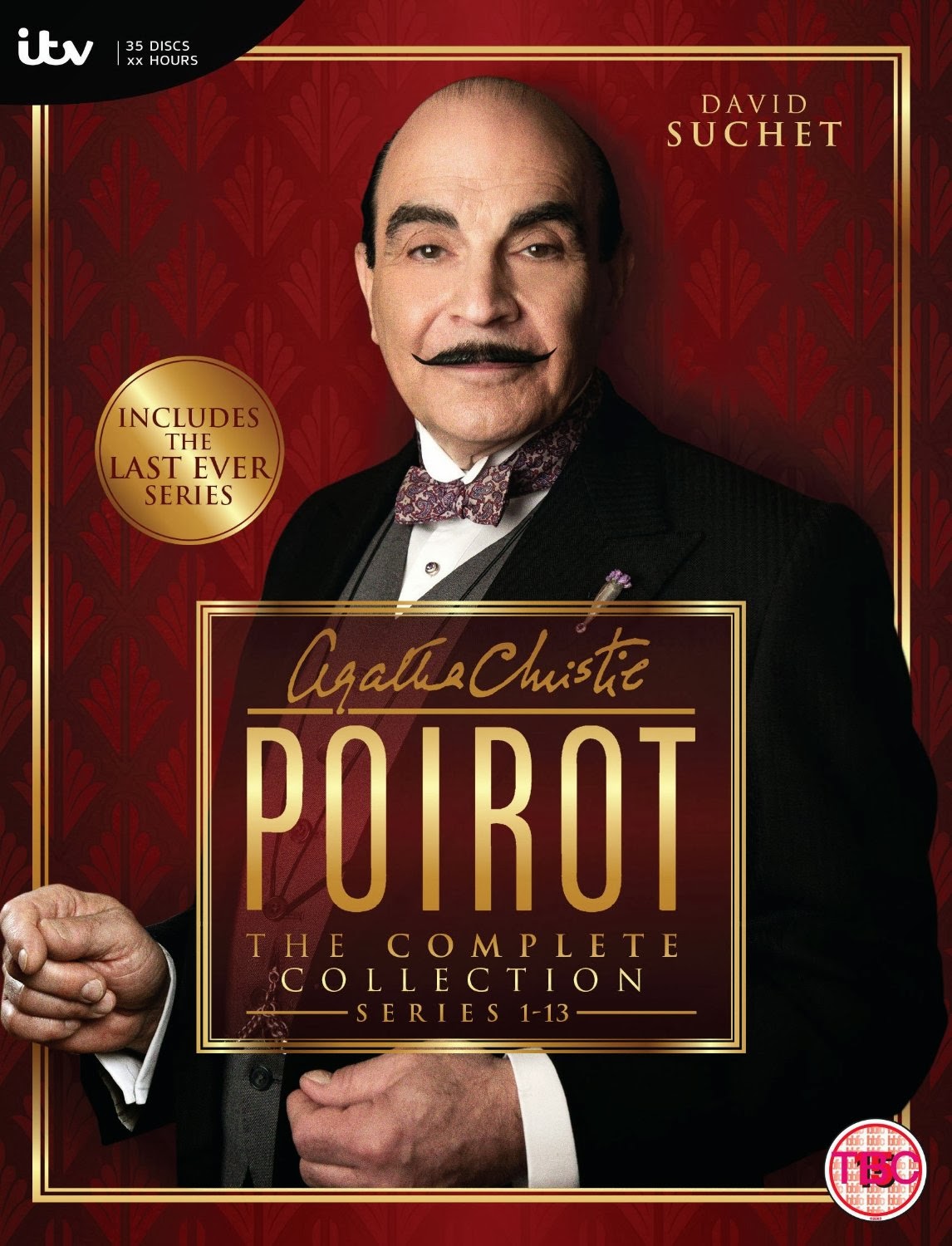
The Definitive Collection will contain all seventy episodes, plus Suchet's Being Poirot documentary, an interview with David Suchet, the David Suchet on the Orient Express documentary and a behind-the-scenes featurette on the making of Murder on the Orient Express.  Collection 9 will contain the final five episodes, plus Suchet's Being Poirot documentary and an interview with David Suchet.

Sunday, 3 November 2013

'The Labours of Hercules': Screenshots from AleKino broadcast

"ueetba", a Poirot fan from Poland, very kindly sent me these screenshots from the broadcast of The Labours of Hercules.


Thursday, 31 October 2013

Adapting Poirot: Q&A with Ian Hallard

(c) ITV

This is a very special blog post! Screenwriter and actor Ian Hallard kindly offered to do a Q&A on the process of adapting Agatha Christie's Poirot stories for television. He has co-written The Big Four (2013) with Mark Gatiss, and acted as a script associate on the other adaptations Gatiss has scripted, Cat Among the Pigeons (2008) and Hallowe'en Party (2010). He also played Edmund Drake in Hallowe'en Party, and appeared in a cameo as Mercutio in The Big Four.

This Q&A offers a rare glimpse behind-the-scenes of the television series we all love. A big thanks to Hallard for taking the time to do this!

SPOILERS on Cat Among the Pigeons, Hallowe'en Party and The Big Four follow. Don't read on if you haven't seen the adaptations.

1) You and Mark have adapted some of the ‘impossible’ Christies. Were you commissioned for these or could you choose from the remaining novels?

Mark was approached due to an existing working relationship with Damien Timmer, the executive producer on the Christies, and asked if he’d be interested in adapting one of the remaining stories. That must have been in about 2005 or 2006, by which time most of the classic novels had already been produced, and ITV were left with an increasingly diminishing pile of books which, with the best will in the world, could not be described as the cream of Dame Agatha’s oeuvre! Nevertheless, we are both lifelong Christie lovers, so we jumped at the chance to collaborate on them. Mark initially said he’d be interested in ‘The Big Four’ purely because of the challenge involved, but instead he was asked to consider ‘Cat among the Pigeons’. Then, a couple of years later, we were asked to do ‘Hallowe’en Party’, presumably because they thought it would be a good match for Mark and his sense of the macabre. And finally, when the last 5 stories were greenlit, after all those years, the call came for ‘The Big Four’. So we pretty much did the ones we were assigned, with the exception of requesting ‘The Big Four’. Though we definitely got the impression that no one else was clamouring to adapt it!

2) How does the process work? Page by page? Script meetings? Producer/Suchet involvement? Number of drafts?

It varies from one script to the next. Usually there will be some kind of discussion with the production team about what we and they think the story needs, and what is achievable on the budget and within the 90 minute time scale. ‘Cat’ was relatively straightforward to adapt, as the structure is strong, and we were able to stick pretty closely to the story beats of the original. ‘Hallowe’en’ is more rambling, so that required more work, and then ‘Four’ even more so. Mark and I spend hours, days, weeks(!), forensically dissecting every element of the plot and the characters – deciding on any themes we want to highlight and what we think is expendable. We talk through all the potential plot holes, logic problems and any restructuring of the plot. Then finally we get on with the writing of it! Once the first draft is delivered, we meet with the producer and the script editor to discuss it, we agree on a set of notes, and then we work on a second draft and the process continues until we’re all happy with what we have. As you get nearer to the shoot and the director has come on board, he may suggest a change based on a particular location that has been found and which would work particularly well for a specific moment. David Suchet deliberately chooses only to read the very last draft or two, because he doesn’t want to get too attached to a scene, a character or even a line that may end up being cut!

3) What constraints are placed on you by ITV, the Christie estate, and the producers? (e.g. costs, creative licence, series continuity, character development?)

We’ve had relatively free rein regarding creative decisions, although it’s a collaborative process, and every adaptation has involved lengthy discussions about what stays and what goes and the overall tenor of an episode.

Some of the decisions are purely logistical. For example, with ‘Hallowe’en’ we were told right from the start that Zoe Wanamaker was only available for the first two weeks of the shoot, which unfortunately meant that Ariadne’s involvement in the story had to be limited in some way. We came up with the idea of a cold confining her to her bed, meaning she could still be a continuing presence, but also that all her scenes could be shot all at once over a day or two and so hopefully you don’t feel her absence too strongly!

You’re constantly aware that even for a high budget, prestige show like ‘Poirot’, the funds are not limitless. So, as we write, we’re bearing in mind that if we include any more than sixteen or so guest speaking characters, we’re going to be asked to cull some of them. Equally, during filming, moving between multiple locations is time-consuming and expensive, so a producer will always be grateful if you can limit the number of different locations, and put as many scenes as possible in the same place. (This is particularly relevant in a more ‘episodic’ story like ‘The Big Four’.)

4) Hastings, Japp and Miss Lemon are back! Could you describe the process of reintroducing them?

Well, we always knew that Hastings was going to be returning in ‘Curtain’, so we wanted ‘The Big Four’ to be mostly Japp’s farewell story. In fact, we were concerned that, after all this time, the emotional impact of Hastings and Poirot’s reunion in ‘Curtain’ might be diluted if we’d only just seen the two of them so recently. For a while we debated whether Hastings should appear in our episode at all! Hopefully we ended up having the best of both worlds by only bringing Poirot and Hastings together in the final minute of the episode.

It was Damien Timmer who suggested we use this as a final ‘walkdown’ for the Old Guard, and of course it’s a nice coincidence that ‘The Big Four’ can refer to Poirot, Hastings, Lemon and Japp as well.

Also – and I don’t think this is really a spoiler – the fact that Poirot stages his own death in the novel gave us the opportunity of dramatising his funeral with his oldest friends, which isn’t something you’ll see in ‘Curtain’.

In terms of their backstories, it’s muddied a bit by the fact that in the series’ chronology, it’s only actually been a couple of years since they all saw each other, whereas of course, in the real world, it’s more like eleven or twelve! Consequently, we’re in a strange situation where the gap feels much longer for the audience than it does for the characters! As a result, we decided to keep the time scale and the circumstances deliberately vague. We wanted a sense that they had drifted apart as people often do, and that as Poirot himself has aged and become a more sombre and solitary character, they have not been part of each other’s lives very much. We leave it to the audience’s imagination as to why this might have come about, but Miss Lemon’s line that she supposes Poirot must have grown used to acting on his own these days, hints at a certain melancholy which fits in with the mood of these final valedictory episodes.

5) Purists’ reactions to the plot changes are mixed, particularly the new ‘denouement’, Achille/Vera/Tysoe. Why were these changes made?

We’ve approached every script with the intention of maximising its strengths and staying as true to the source material as possible. Nothing gets altered or omitted without good reason. Of the three we’ve worked on, ‘The Big Four’ is obviously the adaptation that departs most significantly from the novel – and this is for a variety of reasons.

It’s no coincidence that it’s been left till the very end, and although the book is a lot of fun, I think you’d be hard pressed to describe it as any kind of classic: it does show signs of being cobbled together in a hurry. Poirot suddenly becomes a mixture of Sherlock Holmes and a pre-Bond James Bond; globetrotting, getting kidnapped and blown up, all of which is not very consistent with the character we’ve seen develop in the TV series over the years, especially now he’s in his old age. In addition, the villain who is a ‘master of disguise’ is all very well on the page - but how do you successfully conceal the same actor playing five or six different parts without either the characters or your audience twigging? And the Fu Manchu-like evil ‘Chinaman’ definitely feels like a product of its time and wasn’t an element of the story that we particularly wanted to perpetuate in the twenty-first century!

The one instruction we had from ITV and the producers when we started work was that the adaptation had to, as much as possible, resemble a traditional episode of 'Poirot'. And of course, we knew that the budget would never stretch to filming in a variety of foreign locations with a guest cast of thirty to forty characters. So it was always a case of trying to come up with something which represented the fun and craziness of the novel, whilst still grounding it in some kind of reality.

We decided to focus on the three murder mysteries within the story – ‘Leg of Mutton’, ‘Chess Problem’ and ‘Yellow Jasmine’, as we thought these were stronger than the pure ‘thriller’ episodes where Hastings or Poirot get kidnapped and then escape from the villains. The problem we encountered is that once you accept the notion of the Big Four as this incredibly powerful cabal, with limitless supplies of wealth, power and intelligence at their disposal, the cases do end up seeming rather trivial. For example, in ‘Chess Problem’, Christie has Number Four spending months masquerading as Dr Savaranoff in order to inherit his money. But why bother when you have Abe Ryland – the richest man in the world – on your team?! Then there’s ‘Leg of Mutton’ which has a clever solution, but again, if the terrifying and all-powerful Big Four want to kill off Whalley, why mess about having to dress up as a butcher in order to do it?

So Mark came up with the idea that rather than the Big Four being real, they could all be the fantasy of just one man. That would explain why some of the cases might at first seem comparatively inconsequential, and remove the curse of the secret society which “sounded like something out of a book”. It also gave us something the book doesn’t have and which you ideally want in a Poirot episode – a twist for Poirot to reveal at the denouement. And given that in the book Darrell is an actor, it seemed logical to play up that element and explore the theatrical setting.

We needed a way for our villain to publicise his scheme. How about an ambitious journalist to do the job, and whip up some public hysteria in the febrile atmosphere of 1939? Enter Tysoe. He was then able to be a conduit between Darrell and Poirot and provide a succession of false clues and red herrings.

We lost Countess Rossakoff because we couldn’t find a way to work her into the narrative in this new structure. With Japp, Lemon and Hastings also around, plus the three separate murder mysteries, there simply wasn’t time to do justice to her. And again, we knew she was going to feature in ‘The Labours of Hercules’, so we felt we could cut her with a clear conscience!

Deleting Achille was a much harder decision. It had been one of the things that we’d been excited about doing when embarking on ‘The Big Four’. However, the idea of Achille just being a clone of Hercule seemed a bit dull and rather a wasted opportunity, so for a long while, we considered making him a complete contrast to Poirot: an unshaven, slovenly womaniser. But whilst this would have been fun, ultimately we couldn’t imagine Poirot being able to suppress his fastidiousness sufficiently to convince in the role. He isn’t a master of disguise like Sherlock Holmes after all – so would Japp and the others have gone along with the charade despite presumably seeing through it? (Not even Japp is that stupid, after all!) It would have been fun, but with the plot steam-rolling its way to its conclusion, it just ended up being another element that we would have had to explain with yet further exposition at the end. A shame to lose him, but we wanted to focus on the funeral and Poirot’s reunion with his friends instead.

I did get a tweet from a very angry man who said he was 'livid' and that Mark and I should be arrested for the outrages we had perpetrated on the book! Well, you're never going to please everybody. If you hate the adaptation that much, you can always go back and read the book and you never have to watch the TV version again! Would purists only be happy if they see every single character and episode from the novel faithfully recreated on the screen? The story has to work for an audience who know nothing of the original material, and who have no interest in seeing it preserved in aspic. As long as we're satisfied we've done the best job we can, that's all we can aim for, although of course it is nice if people enjoy your work, and happily we received plenty of positive messages and tweets and only one or two which were negative!

6) Generally speaking, how do you decide what to cut/keep/add/change in the various adaptations?

Sometimes it’s very simple. The novel of 'Cat' had more characters than we could do justice to on screen, so some inevitably had to go, and Miss Vansittart was an obvious candidate. She's really a paler imitation of Miss Bulstrode, so we didn’t feel she would be much missed, plus it made sense to make Miss Rich the second ‘victim’ instead. By having Miss Chadwick fail in her murder attempt, it made her a more sympathetic character, ready for when she redeems herself at the end by saving Miss Bulstrode’s life.

Other changes in ‘Cat’ were made for a bit of added colour. We made Miss Springer nastier, a blackmailer, and killed her with a javelin rather than a gun. (Although when we wrote it we never imagined Ann launching her spear from across the other side of the sports hall - which goes to show you can never predict exactly how a director might choose to interpret your script!)

Ann disguising herself in order to get her hands on the tennis racquet is another example of something which is straightforward on the page but much harder to translate to the screen, so that episode was eliminated. And Miss Blake didn’t have a motive in the book, so we added one, and the intrigue of the voodoo doll gave us a nice segue into the commercial break – which is another thing you constantly have to have in your mind when writing for ITV!

The biggest change was probably involving Poirot right from the start. As a late Christie, she clearly would rather not have had him in it at all, but obviously that was never going to happen!

When it came to ‘Hallowe’en Party’, we knew we’d have to be a bit more inventive. After the startling and arresting image of the murder victim in the apple bobbing tub, the rest of the story is very much late Christie – meandering and a bit repetitive. We wanted to extend the atmosphere and spookiness of Hallowe’en beyond the party itself into the rest of the episode (it gets a bit forgotten about in the book). So we added sequences like Rowena being stalked in the garden, Ariadne’s nightmare and Poirot’s fireside story denouement. Also, most of the characters are single women living alone, which in a dramatisation isn’t much help, as you need characters to interact with each other. It’s all very well being told that Rowena Drake is a dreadful and bossy woman, but far more effective to give her two children to be unpleasant to – then you can show it! And we rather liked the idea of the insular village populated principally by women. The only male residents we see are the elderly vicar, Edmund the mummy’s boy, and strange Leopold. So it’s no wonder all the women are transfixed and swooning at the arrival of the exotic Michael Garfield!

Equally, with a limited number of cast members, you want to maximise your cast of characters and try to make everyone as suspicious as possible. Consequently, we omitted Supt. Spence and his sister, and gave their function to Mrs Goodbody. That’s often the case with an adaptation – you find a way of combining several characters into one: so Mrs Goodbody gets to be a source of information and a suspect and thematic colour as the ‘witch’ at the party.

You also don’t have long to establish each character and give them a motive: you want to make them distinctive enough to give the actor something to get their teeth into and to make them memorable for an audience - particularly when they don't have very much screen time, hence Rev Cottrell being the penny-pinching vicar, Mrs Reynolds the moaning martyr and Frances the bored and boozy vixen!

You quickly realise how succinct you need to be with your story telling to fit everything into ninety minutes. A character or a scene really has to justify their place in telling the story in order to survive being cut.

7) Did the fact that The Big Four is one of the final episodes, essentially a build-up to Curtain, impact your script choices at all?

Impact upon! (That was Mark popping in to make a contribution, by the way.) Other than reuniting Hastings, Japp and Miss Lemon, and giving us the chance to show Poirot’s funeral, not especially. Given the more sombre tone of the later episodes, it had to feel thematically consistent with the rest of the series, which a completely faithful adaptation of the source material would have struggled to do.

8) I also run a Poirot chronology blog. What made you decide on 1939? Have you had a particular series chronology in mind in your three adaptations?

Our brief for all of the episodes has been to keep the period setting as the 1930s. Given that the novel is a departure for Poirot into the world of international intrigue, and as time is marching on for him, it made sense to move the story into the months preceding World War II. Other than that, it’s really the series producer and script editors who keep an eye on that sort of thing. Sometimes the art department ask for a decision on when exactly the script is set to produce a prop, for example a newspaper which requires that information.

9) You mentioned on Twitter that you would have included all of Poirot's friends at his funeral in The Big Four if the budget had been unlimited, and that Ariadne Oliver was in an early draft. Any other scenes or characters you would like to mention that didn’t survive the time/budget constraints, in The Big Four, Cat Among the Pigeons, and Hallowe'en Party?

Yes how wonderful would that have been! To see rows of characters paying their respects – Col. Race, Miss Bulstrode, Supt. Spence, Colin Lamb, Ariadne... It’s always annoying when soap opera characters die and their kids who apparently live in the next town don't bother to show up at the funeral! There was supposed to be a big floral wreath from Ariadne but I'm not sure whether that ended up being shot. And yes, in the first draft, it was Ariadne rather than Hastings who burst through the door at the end with the line “I thought you were dead!”

As for other casualties: there's nothing too significant I think. A romantic scene between Adam Goodman and Ann Shapland had to be dropped from 'Cat' because they ran out of time to shoot it. Mrs Reynolds had a husband in an early draft of 'Hallowe'en' who didn't survive to the final shooting script.

And our first pass at 'Four' experimented with a suggestion of a romantic attraction between Poirot and Mme Olivier (she also inherited some of the characteristics of Countess Rossakoff) – but maybe that would have been a sacrilege too far!

10) There are plenty of references to past episodes in The Big Four. Some fans have also pointed out that there are several nods to Sherlock. Were these deliberate?

Similarities to Sherlock? Well of course the original novel is directly indebted to so many aspects of Conan Doyle's work, which Christie herself actually acknowledges with the sly comment that Poirot makes about all great detectives having brothers who would be even more celebrated were it not for constitutional indolence! Life is littered with so many of these coincidences: even down to the fact that Mark of course plays Mycroft Holmes (the equivalent of Achille) in 'Sherlock'. The irony is that we've been pencilled to work on 'The Big Four' for years now – long before 'Sherlock' was even a twinkle in Mark and Steven Moffat's eyes! And yet Mark, by sheer coincidence, ended up working on 'The Big Four' and his new 'Sherlock' episode 'The Empty Hearse' at more or less the same time, when of course both stories deal with our heroes' apparent demises and subsequent resurrections.

Other nods? Some of them were deliberate: the letter to Miss Bulstrode for instance, the references to Mrs Japp, the lines about “bringing down the curtain”, and the themes of thwarted or frustrated egos - for both Darrell and Flossie – but also for Poirot of course! As Darrell rightly points out, there's absolutely no need for Poirot to stage these elaborate denouements, much less fake his own death – it's just that he adores a theatrical flourish. Both Mark and I have always been interested in that side of the character. Poirot in the books is a vain, pompous, insufferable little egomaniac, so it's fun to tweak everyone's expectations of him, to undercut the image of this twinkly, avuncular figure, and expose the less pleasant side of his personality!

11) Finally, was the new ending (The Big Four) inspired by the story of Suchet's grandparents or the location you filmed in?

Yes, I saw David's interviews about his grandparents, and I'm afraid I have to spoil the romance! We didn't know the story beforehand and it wasn't an inspiration for the film's climax. Nor did we write it with a specific location in mind - Hackney Empire was simply the choice of the production team.

Please do not reproduce without permission. Contact me via e-mail (poirotchronology@gmail.com) or on Twitter (@pchronology).

A big thanks to Tom, a fellow Poirot fan, for brilliant question ideas!

A frame-by-frame look: Polish trailer for 'The Labours of Hercules'!

Labours of Hercules airs tomorrow in Poland, and a trailer has finally been released. ITV also released a press pack today. By the way, this won't be spoiler-free, so if you don't want to know anything - look away now. If you do, then you should read the press pack synopsis as well, because that will help you understand the screencaps.OK. Let's have a closer look:


First shot - and we're in the Swiss Alps! Slightly worried about the obvious CGI work here (understandable as it is, given the budget). The location is taken from 'The Erymanthian Boar', which is the central story of the adaptation (judging by this trailer and the press releases so far).

This is a new character, not present in any of the short stories: Francesco, the owner of the hotel. Fake snow! Hooray.

...aaand more fake snow! The location used is Halton House, Aylesbury.

Here's our leading man. In what looks like Murder on the Orient Express mode? (He's wearing the same coat, scarf and hat)

Now, this is where they lost me. What's going on with the sunglasses? This is in front of the mountain lift they use to get to the hotel (actually built on location next to Halton House, and covered in - you guessed it - more fake snow).

Poirot in an apparently empty reception. This has a sort of At Bertram's Hotel-feel to it, don't you think? (not entirely sure if that's a good thing).

Guest list! Intriguing. There's a certain Countess staying here as well...


So... what's going on here, then? The girl with the necklace is Lucinda LeMesurier (a reference to 'The LeMesurier Inheritance'), according to the press pack.


A painting is missing! 'Hercules Vanquishing the Hydra', according to the press pack.


Something sinister is going on. Very James Bond-ish.


More fake snow and CGI! (But those mountains look quite impressive, actually).

Here's a waiter who doesn't know what he's doing...

Poirot seems to have figured it all out (or has he?). It's his signature 'ah!' move.


Someone is having a bad day... And more James Bond effects!

Alice Cunningham might not be exactly what she appears to be.


Poirot seems to be failing after all. Someone's dead! (Lucinda?)


OK... Schwartz and Cunningham? Guns? Mexican standoff? Not sure about this.

What does everyone think? Judging by the press pack interview with director Andrew Wilson, we're in for a very dark episode exploring Poirot's journey of redemption and retirement.

Thursday, 17 October 2013

First promotional photos from 'The Labours of Hercules'!

(UPDATE 21/10/13: We have a press release and air date - 6 November, 8 pm!)

Here are the first promotional photos for The Labours of Hercules. Image source: ETomlinsonCom on Twitter, www.eleanor-tomlinson.com/thumbnails.php?album=110. Photos linked to their source. Copyright ITV. This particular episode is still a mystery in every sense of the word; very little is known about how this collection of short stories will be adapted into one episode. Any thoughts after seeing these photos?

Thursday, 10 October 2013

The End is Near


A new Poirot trailer has just been released by ITV, to mark the beginning of the end.

It's an incredibly moving trailer, with the voice-over from the final part of Curtain (anyone who has read the book will recognise it), accompanied by clips from several of the episodes, all the way from The Adventure of the Clapham Cook (1989) to what I assume must be Dead Man's Folly (2013) (he's walking between some hedges in a garden, and I don't recognise it from any of the earlier episodes - correct me if I'm wrong).

I particularly enjoy the collage of portrait close-ups of Poirot/Suchet towards the end. It's a beautiful to show the evolution, the aging and the development of the character. Top marks to whoever put this thing together.

See the trailer here: Poirot: The End is Near (trailer) | presscentre

Now, let's speculate. First, we know that The Big Four will air 23rd of October. Here's the press pack, which also includes interviews with David Suchet, Philip Jackson and Sarah Parish (Flossie Monro), and the episode trailer. Second, we are told in the trailer that 'the final four cases of Poirot start with The Big Four'. Third, we know that there will be a preview of Dead Man's Folly at the BFI on the 29th of October. The conclusion to be drawn from this (and from certain rumours I've heard the last couple of days) is that we can probably look forward to Dead Man's Folly on the 30th of October, and possibly even The Labours of Hercules on the 6th of November and Curtain on the 13th. If so, we are only a couple of weeks away from The End. In the words of the trailer:

UPDATE 15/10: ITV have just announced that 'Dead Man's Folly will be broadcast on Wednesday 30th October 2013! Here's the press pack. Thanks to the anonymous commenter who alerted me.

After an incredible journey, the end is near.

Monday, 7 October 2013

'The Big Four': Behind-the-scenes photos and episode screencaps


While we wait for the forthcoming UK broadcast of The Big Four, here are some some set photos and screencaps!


Diana from Germany very kindly gave me permission to post these photos she took on the set of The Big Four earlier this year:


"ueetba", a fan from Poland, did these high quality screencaps from the Polish broadcast. They should be fairly spoiler-free:


About Me

I'm a passionate fan of Poirot, Agatha Christie and the ITV series. If you have any questions, comments, suggestions or requests, please e-mail me at poirotchronology@gmail.com, post a comment on one of my blogs, or get in touch on Twitter @pchronology. (I used to call myself HickoryDickory)